Key Takeaways
- Tourists searching Pocono region Google Maps use category-first searches like 'restaurant near me' rather than specific business names, so your profile must be categorized precisely to show up for those queries.
- Seasonal peaks in the Pocono Mountains compress your opportunity into a small number of high-traffic weekends, which means a weak Maps profile during ski season or fall foliage costs you disproportionately more than it would in a non-seasonal market.
- Inconsistent name, address, and phone number information across directories and your own website lowers Google's confidence in your listing and directly reduces how often you appear in local search results.
- Review recency matters as much as review volume for tourist-facing businesses: visitors make decisions based on what other travelers experienced recently, not years ago.
- The geographic spread of the Pocono region means your Maps visibility is tied to where the searcher is physically standing, not just where your business is located, so website content covering your full service area is a necessary complement to your Maps profile.
Table of Contents
- Why Pocono Region Google Maps Behaves Differently Than Other Markets
- The 5 Things Holding Pocono Businesses Back in Google Maps
- Seasonal Timing: When Pocono Region Google Maps Matters Most
- The Distance Problem in the Pocono Region
- What Businesses in This Region Should Actually Do First
- The Bottom Line on Pocono Region Google Maps Visibility
Pocono region Google Maps is not the same battlefield as local search in a typical suburb. When a plumber in Allentown ranks on Google Maps, they’re mostly competing for neighbors who already know the area. When your business tries to rank in the Poconos, you’re competing for strangers who are 90 miles from home, searching on their phones, and making fast decisions. That changes the rules in ways most generic SEO advice never addresses.
The Pocono Mountains draw millions of visitors each year, according to Visit PA (Pennsylvania tourism office), and a huge portion of that traffic is concentrated into a handful of peak weekends in summer, fall foliage season, and ski season. If your Maps listing is weak during those windows, you don’t just miss a few clicks. You miss the best revenue opportunities of your year.
Why Pocono Region Google Maps Behaves Differently Than Other Markets
In most towns, the people searching for your business on Google Maps live within 10 to 15 miles of your location. They’ve driven past your sign. They might recognize your name. Their searches tend to be deliberate, like “same-day HVAC repair Stroudsburg” or “dentist East Stroudsburg.”
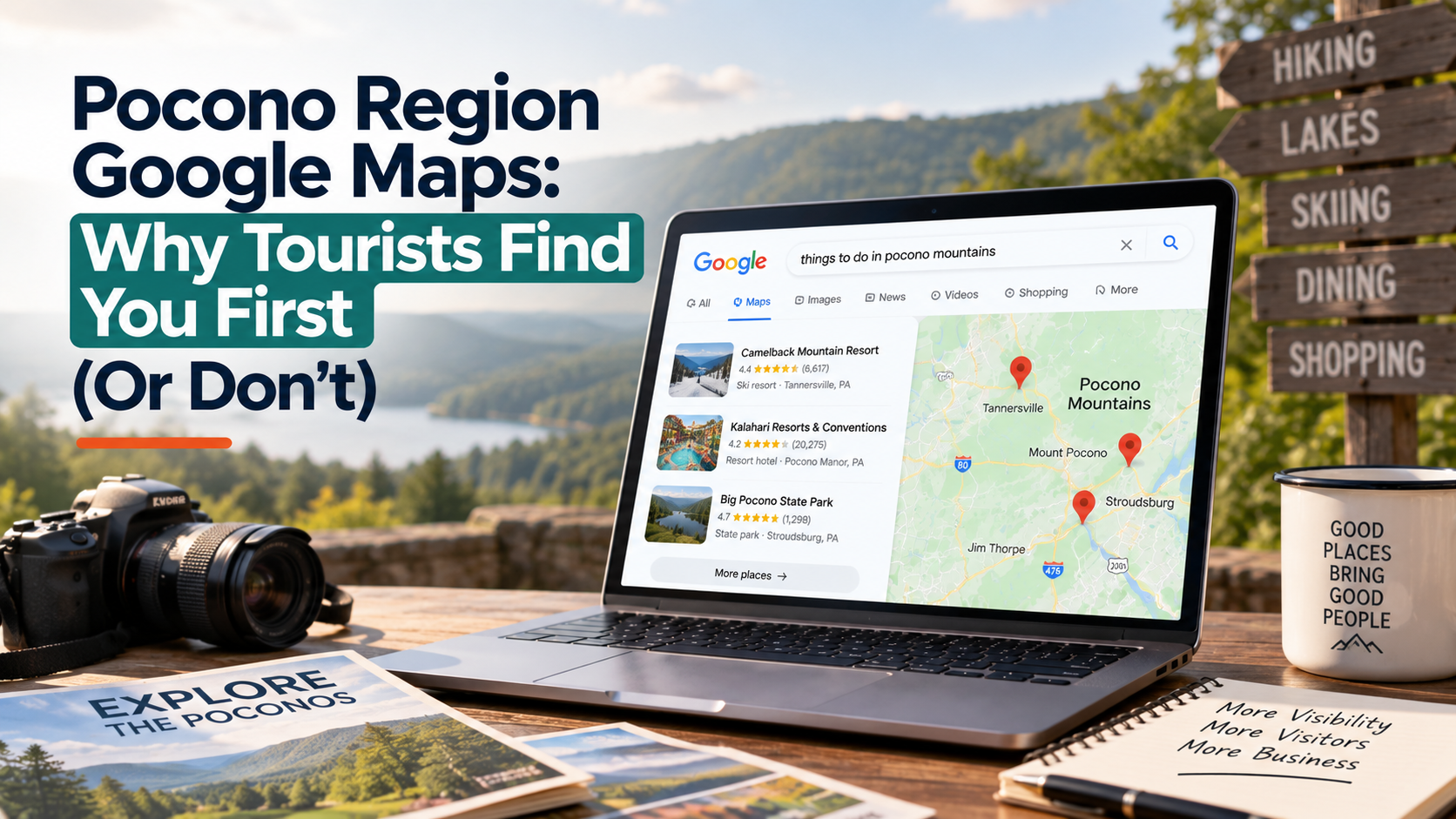
Tourists don’t search that way. A family driving up Route 80 from New Jersey is searching things like “restaurants near me,” “things to do in the Poconos,” or “convenience store open now.” They have no idea what town they’re in. They don’t know the difference between Pocono Summit, Pocono Pines, and Pocono Manor. They’re searching by category and proximity, not by neighborhood or business name.
That means your Pocono region Google Maps presence needs to be optimized for category-first searches, not just branded or hyper-local terms. If Google doesn’t clearly understand what your business does, it won’t surface you to the visitor who’s five minutes down the road looking for exactly what you offer.
The 5 Things Holding Pocono Businesses Back in Google Maps
After working with businesses across Monroe, Pike, and Wayne counties, certain problems show up again and again. Here’s what actually moves the needle, in order of impact.
1. A Weak or Unclaimed Google Business Profile
This is still the most common problem. Some businesses in the Pocono region have never claimed their profile, which means Google is pulling information from whatever it can scrape together. Hours may be wrong. The category may be generic. Photos may be missing entirely.
Tourists searching Pocono region Google Maps see your listing next to competitors who have 40 photos, updated hours, and a clear description. That comparison alone loses you customers before they’ve read a single word about your actual business.
2. Wrong or Missing Business Categories
Your primary Google Business Profile category is one of the strongest local ranking signals Google uses. If you run a kayak rental shop in Milford but your primary category is something vague like “Outdoor Recreation” instead of “Canoe and Kayak Rental,” Google won’t show you when someone searches for exactly that service near the Delaware Water Gap.
You can add secondary categories too, and most businesses in this region should. A lakeside resort might legitimately qualify for lodging, dining, and event venue categories all at once. Get specific, and get all of them listed. We explain this in more depth in our post on what your Google Business Profile category actually does to your local rankings.
3. Inconsistent Business Information Across the Web
Google cross-references the name, address, and phone number listed on your Google Business Profile against dozens of other sites: Yelp, TripAdvisor, Apple Maps, local directories, and your own website. If your address says “Route 940” in one place and “PA-940” somewhere else, or your phone number changed two years ago and the old one still appears on five directory sites, Google loses confidence in your listing. Lower confidence means lower rankings on Pocono region Google Maps, especially for searchers who aren’t already in town.
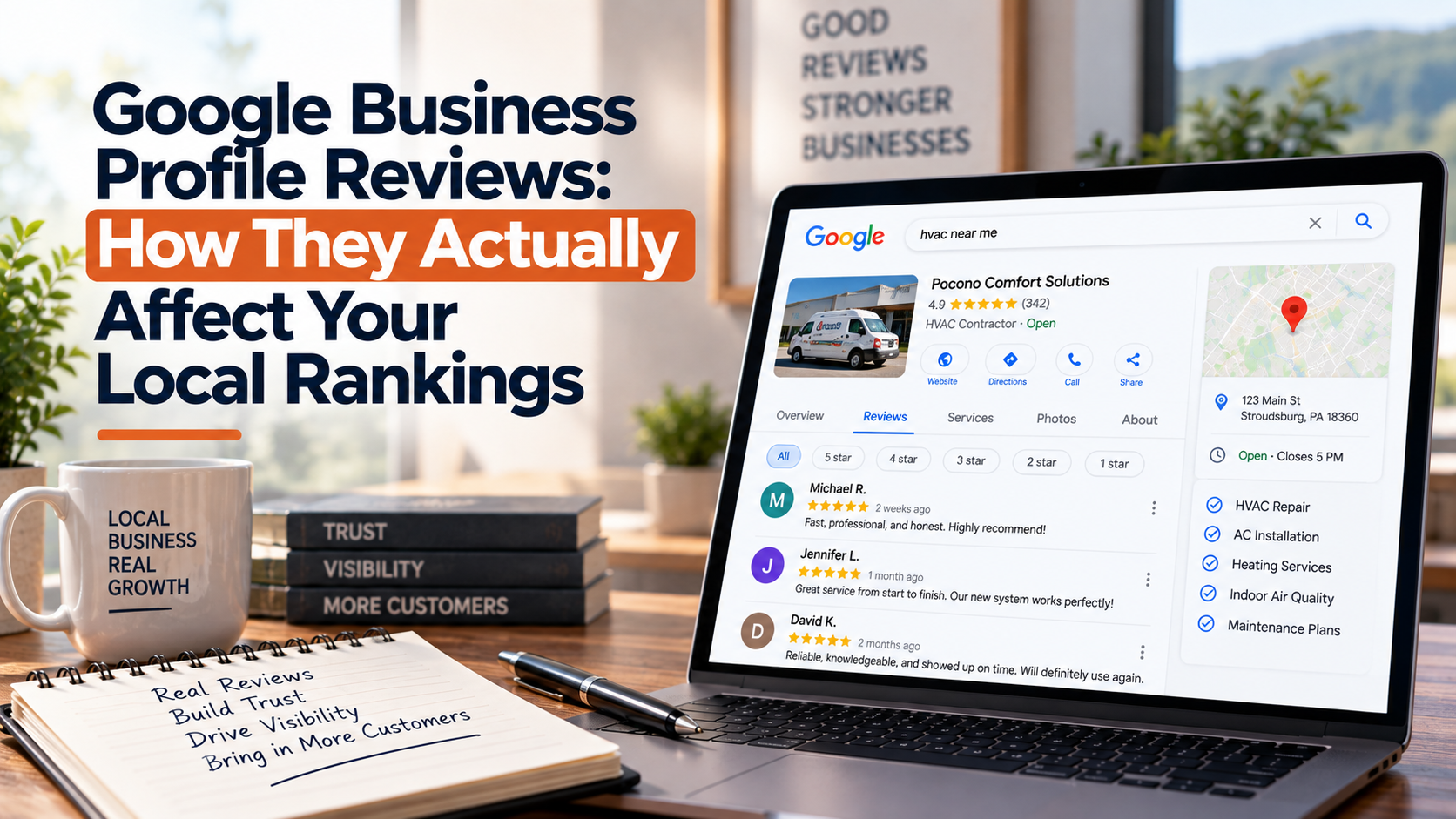
4. Reviews That Are Old, Sparse, or Never Answered
Tourists deciding between two similar options on a Maps screen are going to pick the one with more recent, positive reviews. A restaurant in Hawley with 200 reviews averaging 4.6 stars wins over a restaurant with 30 reviews averaging 4.2 every single time, even if the food is genuinely better at the second place.
Review recency matters too. A pile of glowing reviews from 2021 doesn’t reassure someone booking a weekend trip in 2025. They want to know what the experience was like last month. Build a consistent review collection habit, not a one-time push.
And answer every review. Not with a template, but with a real sentence or two. Google sees that engagement as a signal that the business is active and attentive.
5. Photos That Are Generic or Out of Date
On Pocono region Google Maps, your photo gallery is often the deciding factor between a click and a scroll-past. Tourists are making emotional decisions about how they want to spend their weekend. A picture of your actual lakefront, your actual storefront in fall foliage, or your actual team at work does more than any paragraph of description.
Upload new photos regularly. Tag them with your location where possible. Google’s own data shows that listings with more photos get significantly more direction requests and website visits, and in a tourist-heavy market like the Poconos, that gap is even wider.
Seasonal Timing: When Pocono Region Google Maps Matters Most
The Pocono Mountains have four distinct tourist seasons, and your Maps optimization strategy should reflect that. Summer weekends at lake houses, October leaf-peepers, ski season from December through February, and spring “escape the city” weekends each bring a different type of searcher with different intentions.
If you run a seasonal business or a business with seasonal peaks, your Google Business Profile should reflect those peaks proactively. Update your hours before the season changes, not after you’ve already missed a weekend. Post updates about seasonal offerings. If you rent snowmobiles, make sure those keywords appear naturally in your description before December, not in January after the season is already rolling.
This also matters for service businesses. HVAC companies in this region see emergency calls spike during cold snaps and summer heat waves. Being visible on Pocono region Google Maps during those moments is the difference between a fully booked week and watching the phone sit quiet. We cover how that timing works specifically for HVAC and plumbing SEO in a separate post if that’s your industry.
The Distance Problem in the Pocono Region
The Pocono Mountains region covers a lot of ground. A business in Milford, PA is not competing for the same searches as a business in Tobyhanna, even if they’re technically both in the Poconos. Google uses the searcher’s physical location at the moment of the search to decide which businesses to show, which means your Maps visibility depends on where the person is standing when they search, not just where they’re ultimately going.
This matters most for businesses that serve multiple Pocono communities or that want to reach visitors passing through on Route 80, Route 6, or Route 209. A wider service area claim on your profile, paired with location-specific pages on your website, helps Google understand that you legitimately serve those areas. Without that, you may only appear to people who are physically very close to your front door.
Our piece on how Google decides how far your business shows up in local search walks through the mechanics behind this if you want to dig deeper into the proximity factor.
What Businesses in This Region Should Actually Do First
Here’s a plain-language priority list, ordered by effort versus impact for a typical Pocono region business:
- Claim and fully complete your Google Business Profile if you haven’t done this already.
- Choose the most specific primary category that matches your core service or product.
- Audit your NAP (name, address, phone) consistency across Google, Yelp, Apple Maps, TripAdvisor, and your website.
- Upload at least 10 high-quality, current photos showing your actual space, products, or work.
- Build a process for asking customers to leave reviews and respond to every one that comes in.
- Update your hours proactively before each seasonal shift, not the Monday after a busy weekend when you’ve already missed calls.
- Add location-relevant content to your website so Google can connect your Maps profile to pages that actually talk about the communities you serve.
None of these are complicated in isolation. The challenge is doing all of them consistently while running a real business. That’s where working with a team that focuses specifically on local SEO services for small businesses pays for itself quickly, especially in a market with as much tourist traffic concentration as the Pocono region.
The Bottom Line on Pocono Region Google Maps Visibility
Generic Maps advice treats every local business the same. A business in the Pocono Mountains is not the same as a business in a quiet residential suburb. You have a shorter window to capture tourist attention, a more geographically spread-out service area, and a seasonal pattern that means the stakes during peak weekends are disproportionately high.
The businesses that consistently appear at the top of Pocono region Google Maps results aren’t there by accident. They’ve built profiles that Google trusts, with specific categories, consistent information, fresh reviews, and real photos. That’s a manageable foundation, and it’s one that compounds over time. Start with the basics, do them well, and your Maps presence will reflect the effort every time someone comes off the highway looking for what you offer.
Frequently Asked Questions
Why does my Pocono business show up on Google Maps for some searches but not others?
Google uses your physical location relative to the searcher, your business category, and the strength of your overall profile to decide when to show you. If your category is too vague, your information is inconsistent across the web, or your profile is thin on photos and reviews, you’ll only appear for a narrow slice of relevant searches. Fixing those three areas typically broadens your visibility significantly.
Do tourists actually use Google Maps when visiting the Pocono region?
Yes, and at a very high rate. Most visitors are traveling from out of the area and rely on their phones to find restaurants, activities, fuel, and services on the fly. Being visible on Google Maps during peak travel weekends in the Poconos is one of the highest-value marketing positions a local business can hold.
How many photos should my Google Business Profile have for a Pocono region business?
There’s no magic number, but businesses with 20 or more photos consistently outperform those with fewer in terms of clicks, calls, and direction requests. For tourism-adjacent businesses in the Pocono region, showing real photos of your location, products, and team is especially important because tourists can’t rely on word-of-mouth or local familiarity to fill in the gaps.
Does my website affect my Google Maps ranking in the Pocono region?
Yes. Google connects your Maps profile to your website and uses the content there to verify what your business does and where it operates. If your website has pages that mention specific Pocono communities, relevant services, and location-specific detail, Google becomes more confident in showing you for local searches across the region.
How often should I update my Google Business Profile for seasonal changes in the Poconos?
Update your hours and business description at least two weeks before each major season shift. The Pocono region has four meaningful tourist seasons, and tourists searching before their trip or on their way up will see whatever your profile says at that moment. Outdated hours are one of the fastest ways to lose trust with a new customer before they’ve ever walked through your door.