Key Takeaways
- Emergency HVAC and plumbing searches convert at very high rates, so ranking in the top three Map Pack results is not a nice-to-have but a direct driver of how many calls you receive.
- Your Google Business Profile, kept fully updated and actively managed, is the single highest-leverage tool in HVAC and plumbing SEO and should be the first thing you fix.
- Inconsistent business name, address, or phone number across your website, Google profile, and directories is one of the most common and most damaging SEO mistakes for trade contractors.
- Each major service you offer (water heater replacement, drain cleaning, furnace repair) needs its own dedicated website page targeting that specific search plus your service area city.
- Collecting two to four fresh Google reviews every month consistently outperforms a one-time burst of reviews and signals to Google that your business is active and trusted.
Table of Contents
HVAC and plumbing SEO is the practice of making your contracting business the first result a homeowner sees when they search for help, especially during emergencies when they are ready to hire immediately. It is not about gaming an algorithm. It is about making sure Google has enough clear, consistent information about your business to trust it and show it to people who need you right now. For HVAC and plumbing companies, that window of intent is short and the stakes are high, which makes visibility far more valuable than it is for almost any other type of business.
This guide is written for owners and operators of HVAC and plumbing businesses who are tired of vague marketing advice and want to know what actually moves their phone. We are going to walk through the specific signals Google uses, why emergency searches behave differently than general searches, and what you should prioritize first.
Why Emergency Search Visibility Is Different for Trades
Most local businesses can afford to compete slowly. A restaurant can build a following over months. A salon can lean on referrals for years. HVAC and plumbing SEO operates in a completely different environment because your most valuable customers are not browsing. They are in a crisis.
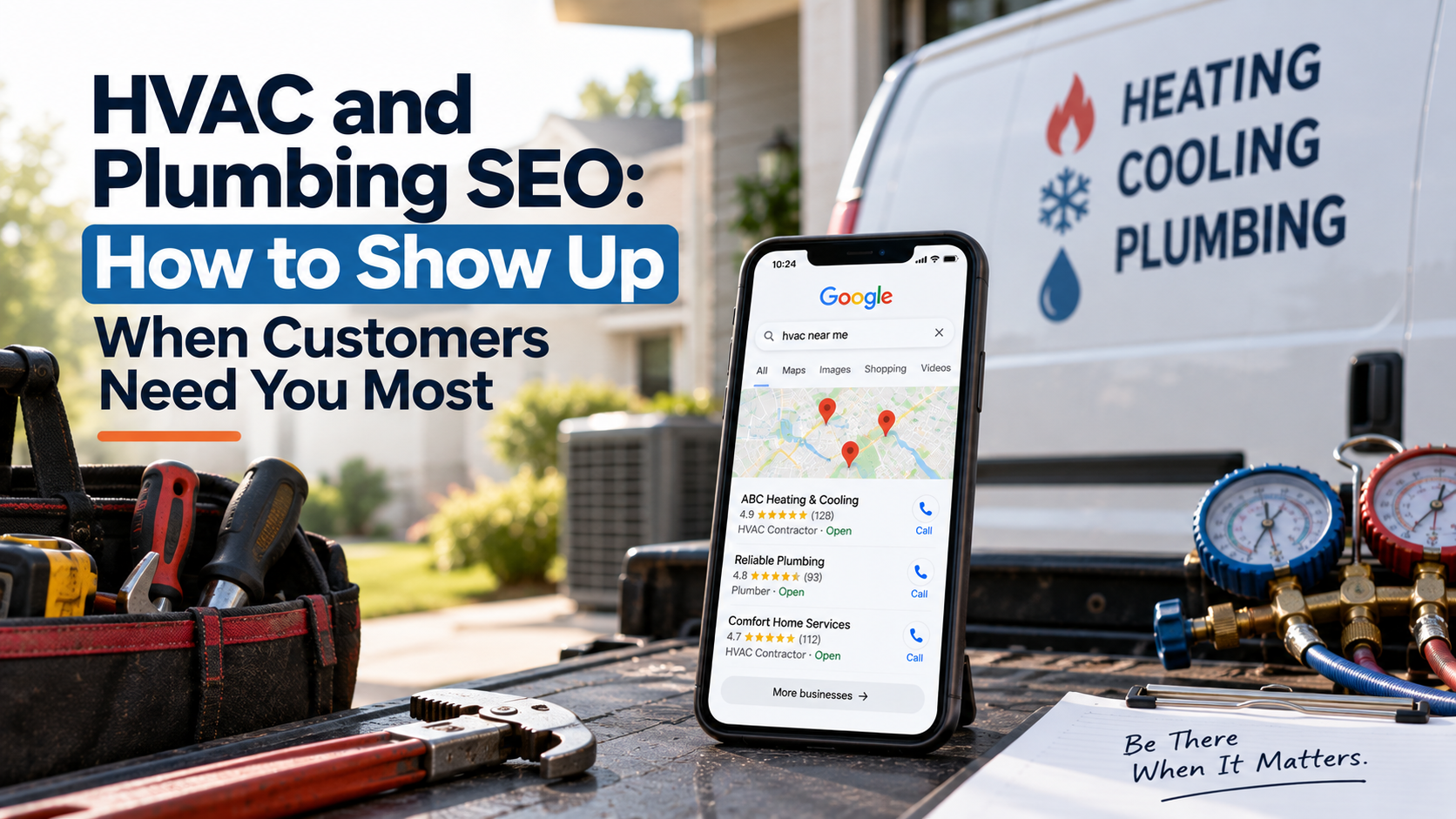
A homeowner searching “emergency plumber near me” at 11 PM is not comparing five websites. They are calling the first result that looks credible and has a phone number they can tap. Studies of local search behavior consistently show that most clicks go to the top three results in Google’s Map Pack, and for emergency queries, the conversion rate on those clicks is extremely high. People are not window shopping. They need help now.
This means that for HVAC and plumbing contractors, being on page two is essentially the same as being invisible. It is not a slight disadvantage. It is close to a total loss of that lead.
The 5 Levers That Actually Drive HVAC and Plumbing SEO Results
1. Your Google Business Profile Is Your Most Important Asset
Before you spend a dollar on ads or a redesign, your Google Business Profile needs to be complete, accurate, and active. For HVAC and plumbing SEO, this single listing drives more emergency calls than almost anything else in your marketing stack.
- Choose the right primary category. “Plumber” and “HVAC contractor” are specific categories. Using a vague one like “home services” costs you visibility. Your primary category has a direct effect on which searches trigger your listing, so get this right.
- List every service you actually offer. Emergency drain clearing, furnace tune-ups, water heater replacement, AC installation. Every service you add gives Google more context for when to show you.
- Set your real service area. If you cover a 30-mile radius, list those zip codes or cities. Google uses this to determine how far out to show your business in searches.
- Post updates at least twice a month. Active profiles signal to Google that the business is operating. A profile that has not been updated in six months looks dormant.
- Answer every review, including negative ones. Homeowners read review responses. A calm, professional reply to a complaint builds trust faster than a dozen five-star reviews with no engagement.
2. Build Service Pages That Match How People Actually Search
Your website needs dedicated pages for each major service, not one giant page that lists everything you do. A homeowner searching “water heater replacement [your city]” should land on a page that talks specifically about water heater replacement, includes your service area, and gives them a clear way to call or book.
Generic pages hurt HVAC and plumbing SEO because Google cannot tell what the page is specifically about. One page that tries to cover drain cleaning, water heaters, sump pumps, and pipe repair all at once will rank for none of those searches reliably.
A realistic structure for a plumbing company website looks like this:
- Homepage (brand, service area, trust signals)
- /drain-cleaning-[city]
- /water-heater-replacement-[city]
- /emergency-plumber-[city]
- /leak-detection-[city]
- /sewer-line-repair-[city]
Each page targets one specific search. Each page proves you do that work in that area. This is how you capture the searches that matter most, and it is one of the first things we look at when running a free local SEO audit for a new client.
3. Licensing and Trust Signals Are Part of Your SEO Strategy
HVAC and plumbing work is licensed in almost every state. Homeowners know this. They are looking for proof that you are legitimate before they let a stranger into their home. Google knows this too, which is why trust signals are not just a conversion issue, they are an SEO issue.
Put your license number on your website. Display your insurance information. Show any certifications you hold. The Plumbing-Heating-Cooling Contractors Association offers membership and credentialing that can serve as a visible trust signal for both homeowners and search engines looking at your site’s authority.
Beyond credentials, make sure your NAP data (name, address, phone number) is identical everywhere it appears: your website, your Google Business Profile, Yelp, Angi, HomeAdvisor, and any trade directories. Inconsistent contact information is one of the most common reasons legitimate HVAC and plumbing businesses lose ground in local search, even when their work is excellent.
4. Reviews Are Not Optional for Local SEO for Home Services
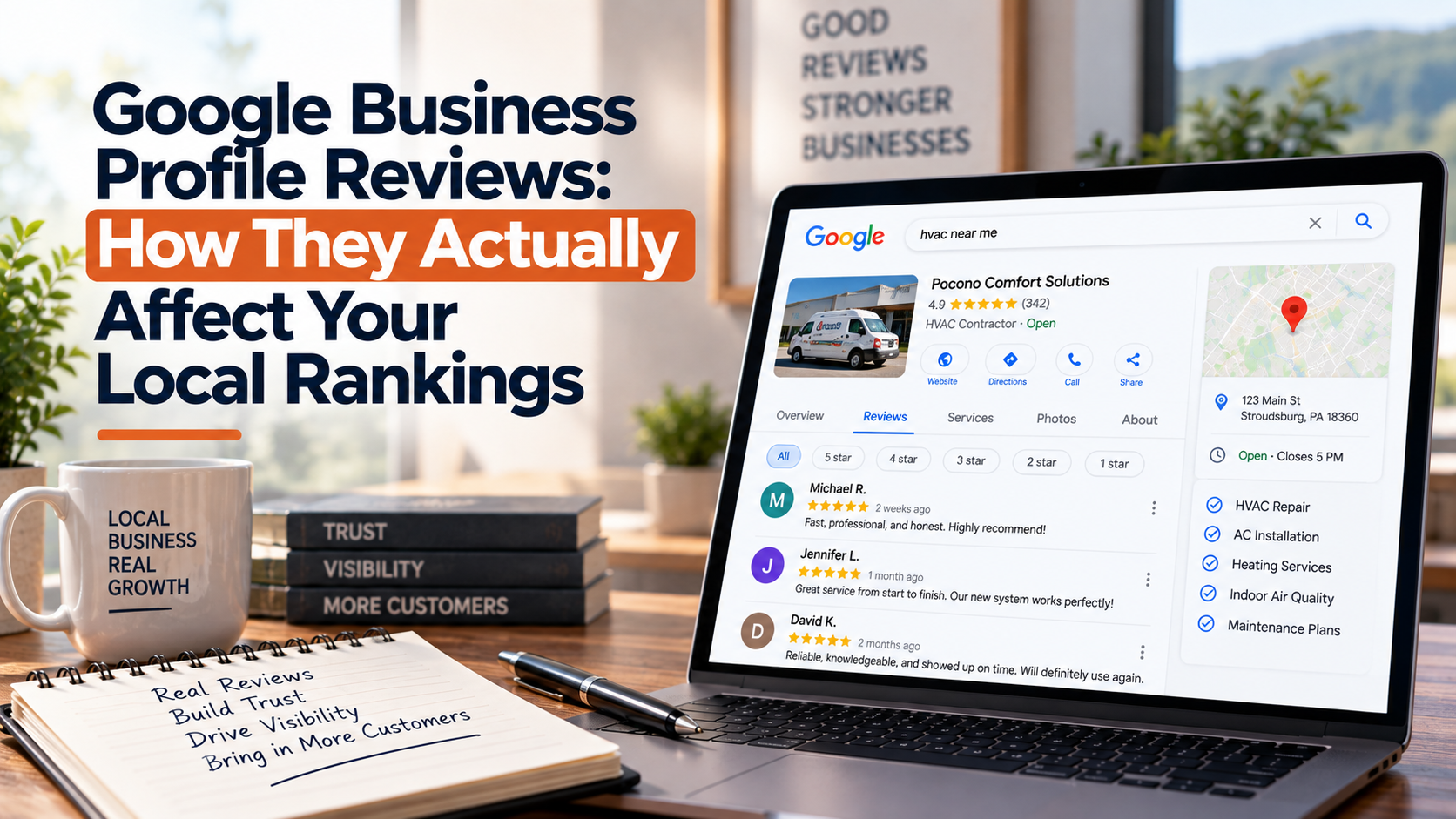
Google weighs review quantity, recency, and relevance when ranking local businesses. For HVAC and plumbing SEO specifically, reviews that mention the service type and location carry extra weight. A review that says “fixed our furnace same day in Stroudsburg” does more for your rankings than a generic five-star review with no text.
The practical fix is simple: ask every happy customer to leave a review right after the job is done. Send a follow-up text with a direct link to your Google review page. Most people who had a good experience are willing to leave a quick note. Most just never think to do it unless you ask.
Aim to get at least two to four new reviews per month consistently. A steady stream of recent reviews signals an active, trusted business. A burst of twenty reviews followed by six months of silence can actually look suspicious to Google’s ranking systems.
5. How Distance Affects Where You Show Up (and What to Do About It)
Google uses physical proximity as a major factor in local search results. This means a plumber based in the center of town has a natural advantage over one based on the edge of their service area for searches originating in that town. You cannot fully override proximity, but you can work around it.
If you serve multiple towns, create location-specific landing pages for each major service area. These pages need real content about that area, not just a city name swapped into a template. Mention local landmarks, local permit requirements if they are different, or specific challenges in that area (older housing stock, well water systems, whatever is genuinely relevant).
Understanding exactly how Google calculates distance and radius for local results helps you set realistic expectations and prioritize which areas to target first. This breakdown of how Google decides how far your business shows up in local search is worth reading before you build out your location pages.
Where Most HVAC and Plumbing Companies Fall Behind
The most common failure we see is not a technical SEO problem. It is a consistency problem. HVAC and plumbing businesses often have a decent website and a Google Business Profile, but the two do not match each other. The business name is slightly different. The phone number is an old one. The service area on the website says something different from the profile.
Google interprets inconsistency as unreliability. It does not know which version of your business information is correct, so it hedges by showing you less often. Fixing this is not glamorous work, but it has an outsized impact on visibility, and it is something our local SEO services tackle in the first week of any new engagement.
The second most common issue is that contractors invest in getting new customers but do almost nothing to hold their search position once they have it. Local SEO for home services is not a one-time project. Competitors add new content, collect more reviews, and update their profiles. Standing still means falling behind.
A Practical Starting Point
If you are not sure where your HVAC and plumbing SEO currently stands, start by searching your top service and city name from a private browser window or a phone that is not logged into your Google account. If you are not in the top three Map Pack results, you have work to do. Check whether your Google Business Profile is fully filled out, whether your website has individual service pages, and whether your contact information matches everywhere it appears online.
Those three checks alone will tell you most of what you need to know about why you are or are not showing up when customers need you most. Fix what is broken, build what is missing, and stay consistent over time. That is the whole strategy, without the jargon.
Frequently Asked Questions
How long does HVAC and plumbing SEO take to show results?
Most HVAC and plumbing companies see meaningful movement in local search rankings within 60 to 90 days of fixing their Google Business Profile, cleaning up inconsistent contact information, and adding dedicated service pages. Competitive markets may take 4 to 6 months to see the top three Map Pack positions. The timeline depends heavily on how optimized your competitors are and how active your profile is relative to theirs.
Do I need a separate website page for every service I offer?
Yes, for your main services you do. A single combined services page rarely ranks well for specific searches like ’emergency drain cleaning’ or ‘furnace replacement near me’ because it tries to cover too many topics at once. Each major service paired with your service area deserves its own dedicated page with specific content, a clear call to action, and your credentials relevant to that service.
Is paid advertising better than SEO for emergency HVAC and plumbing leads?
Paid ads (Google Local Services Ads in particular) can get you to the top of the page faster, but the moment you stop paying, the leads stop. Organic HVAC and plumbing SEO builds a position that continues to generate calls without a per-click cost. For most small contractors, the best approach is to run ads while building organic visibility, then rely more heavily on organic as rankings improve.
How many reviews do I need to compete in local HVAC and plumbing searches?
There is no magic number, but in most mid-sized markets, the top-ranking contractors have 50 or more Google reviews with consistent recent activity. If your competitors have 80 reviews and you have 12, that gap is affecting your rankings. Focus on getting 2 to 4 new reviews per month consistently rather than trying to collect 40 at once, which can look unnatural.
Does my HVAC or plumbing company need a new website to rank well?
Not necessarily. An existing website can often be improved without a full rebuild by adding service-specific pages, updating contact information, improving page speed, and making the site mobile-friendly. That said, if your current site is slow, hard to navigate on a phone, or built on outdated technology, a rebuild may be the more efficient path. The website’s job is to convert visitors who find you. If it is not doing that, rankings alone will not fix your lead flow.