Table of Contents
Google local search distance determines how far from your physical location (or service area center) your business appears in map results. In plain terms, it sets the invisible radius inside which customers can actually find you. That radius is not fixed. It shrinks or expands based on factors you can control, and most small business owners have no idea those factors exist.
If you have ever noticed that you rank well for customers a mile away but seem invisible to someone five miles out, this is almost certainly why. The good news is that understanding the mechanics behind google local search distance gives you a real path to fixing it, without spending a fortune.
Why Distance Is Only One Piece of the Puzzle
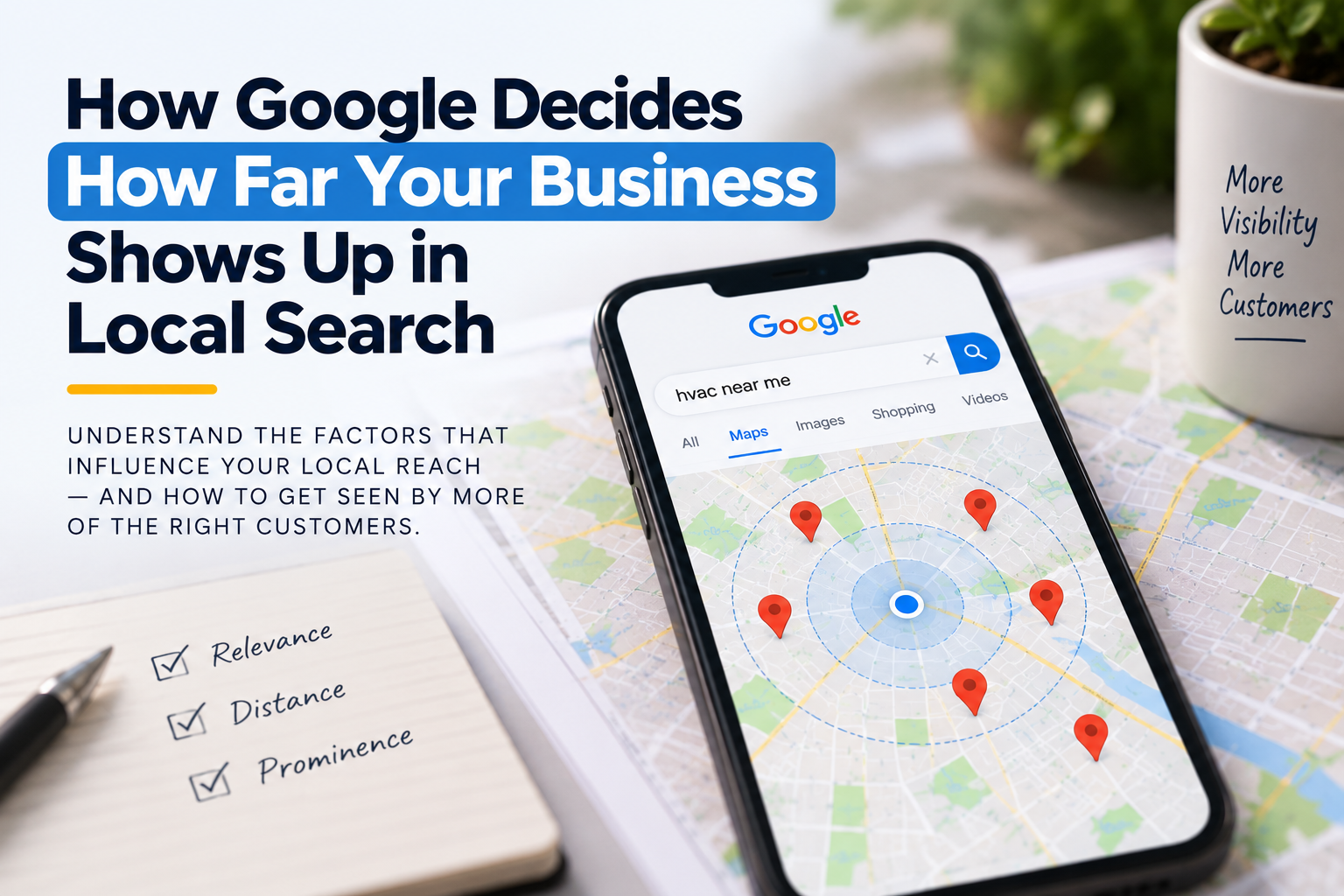
Google uses three core signals to decide which local businesses show up in the map pack: relevance, distance, and prominence. Distance is the one most owners fixate on because it feels simple. But Google does not just ask “how close is this business to the searcher?” It also asks “how relevant and how well-known is this business compared to its competitors at this distance?”
This is why a plumber with 80 five-star reviews can outrank a closer competitor with 6 reviews. Google is willing to stretch its local search ranking radius for a business that looks credible and well-matched to the search, even when that business is a few miles farther away. Proximity alone does not win.
For a deeper look at exactly what Google weighs, this post on what Google actually looks at when ranking local businesses in the map pack walks through each signal without the jargon.
What Actually Shrinks Your Google Local Search Distance
Several common problems cause your effective reach to shrink. These are not technical mysteries. They are practical gaps that Google notices when it is deciding whether to show you to someone five miles away versus only one mile away.
1. A Thin or Incomplete Google Business Profile
Google needs enough information to feel confident recommending your business. When your profile is missing hours, photos, a real description, or service details, Google treats it as a lower-confidence result. Lower confidence means a tighter, shorter google local search distance. It will show you close up where it has no better option, but it will not take the risk of showing you to someone farther away when a more complete competitor is available.
If you are unsure what “complete” actually means for your profile, the Google Business Profile Help Center has straightforward guidance on every field and what each one does.
2. The Wrong Business Category
Your primary category is one of the biggest signals Google uses to match your business to searches. If your category is too broad or just slightly off, Google will not connect you to the right searches, and your map pack visibility shrinks as a result. A heating and cooling company listed as “contractor” instead of “HVAC contractor” is essentially telling Google it does not know what you do.
There is a full breakdown of how category selection affects your rankings in this post on what your Google Business Profile category actually does to your local rankings.
3. Few or Inconsistent Reviews
Reviews are one of the clearest signals of real-world prominence that Google can read. A business with 4 reviews is a gamble for Google to show to someone eight miles away. A business with 60 reviews and steady new ones coming in feels like a safer bet. Google local search distance expands as your review count and recency grow, because prominence goes up with them.
Recency matters almost as much as total count. A business with 100 reviews and none in the past year looks stale compared to one with 40 reviews that got 8 of them in the past 60 days.
4. No Location Signals on Your Website
Your website backs up what your Google Business Profile claims. If your site does not mention your city, your service area, or your neighborhood anywhere in the content, Google has less confidence that you actually serve that geography. Thin location signals on your site can cap your service area ranking even if your profile looks solid.
This does not mean stuffing city names into every paragraph. It means writing naturally about the area you serve, having a contact page with a real address or service area, and making it clear in your content that you are a local business serving a specific region.
5. No Activity or Updates on Your Profile
Google favors active profiles. A business that posts updates, responds to reviews, adds photos, and keeps its information current signals that it is open, engaged, and worth recommending. A profile that has not been touched in a year signals the opposite. Activity does not dramatically override other factors, but it does help maintain your local search ranking radius rather than letting it quietly shrink over time.
How to Expand Your Google Local Search Distance
Expanding your effective reach is not a one-time fix. It is a combination of small, consistent improvements that compound over time. Here is a practical starting point:
- Fill in every section of your Google Business Profile, including services, a real business description, hours, and photos of your actual work or location.
- Pick the most specific primary category that accurately describes your core service, not the broadest one that technically fits.
- Ask every satisfied customer for a review, and reply to every review you get, positive or negative. Engagement signals matter.
- Add location-specific content to your website, mentioning the cities and communities you serve in a natural, readable way.
- Post to your Google Business Profile at least twice a month, even short updates about completed jobs, seasonal tips, or new services.
- Build citations (consistent name, address, and phone number listings) on reputable directories like Yelp, Angi, and industry-specific sites. Consistency across the web reinforces your location signals.
None of these steps require technical expertise. They require consistency, which is something most small business owners are capable of but rarely have time to prioritize.
Service Area Businesses Have a Different Challenge
If you do not serve customers at a physical location, but instead drive to them, you are a service area business (SAB). The google local search distance math works a little differently for you. You do not have a storefront address as an anchor, so Google relies even more heavily on your service area settings in your profile, your review locations, and your website content to estimate your range.
For SABs, reviews that mention specific cities are especially valuable. When a reviewer says “called them out to our place in Stroudsburg” or “best HVAC tech in East Stroudsburg,” Google picks up on those location mentions and factors them into where it is willing to show you. It is organic geographic signal that no settings panel can fully replicate.
If you are a seasonal business or one whose search demand shifts through the year, your ranking radius can fluctuate with it. This post on Pocono SEO for seasonal businesses covers how to keep your visibility strong during peak demand windows specifically.
The Honest Reality About Local Search Radius
There is no setting inside your Google Business Profile that lets you type in “show me within 15 miles.” Google controls that based on the competition in your category, the density of businesses in your area, and how strong your own signals are relative to everyone else. You cannot force your google local search distance to expand overnight, but you can make your profile stronger, more credible, and more complete than the competition, and over weeks and months, your reach grows.
If you are not sure where your profile currently stands or what specific gaps are costing you reach, a free local SEO audit can show you exactly where you are losing ground and what is worth fixing first, without sitting through a sales pitch.
Summary: What to Take Away
Google local search distance is not a locked setting. It is an outcome of how complete, credible, and active your local presence looks compared to your competitors. Proximity to the searcher matters, but it is just one input. Relevance, reviews, profile completeness, website signals, and consistent activity all shape how wide or narrow your effective reach is in the map pack. Fix the gaps, stay consistent, and your radius grows.
Frequently Asked Questions
Why does my business show up for nearby customers but not for people a few miles away?
This is a google local search distance problem. When your profile lacks reviews, complete information, or strong location signals, Google only feels confident enough to show you to searchers very close by. Improving your profile, earning more reviews, and adding location content to your website gradually expands that radius.
Can I set a specific distance radius in my Google Business Profile?
No. Google decides how far to show your business based on your relevance, prominence, and proximity compared to competitors. You can set a service area in your profile, but that does not guarantee Google will show you to every searcher inside it. Stronger signals increase how often and how far you appear.
Do reviews actually affect how far away customers can find me?
Yes, in a real way. Reviews contribute to your prominence score, which Google uses alongside distance and relevance. A business with more credible, recent reviews is one Google is more willing to surface for searchers farther away. Recency matters too, so steady new reviews outperform a large total count with nothing recent.
I do not have a storefront. Can I still expand my local search ranking radius?
Yes. Service area businesses expand their reach by setting accurate service areas in their profile, earning reviews that mention specific cities or towns, and publishing website content that references the communities they serve. Google uses these signals to estimate your geographic footprint when there is no physical address to anchor on.
How long does it take to see my map pack visibility improve?
There is no universal timeline. Small improvements to a neglected profile can show movement within a few weeks. Building up reviews and website signals typically takes two to four months to make a noticeable difference in how far your business appears. Consistency over time matters more than any single change.