Key Takeaways
- Local SEO for law firms works by combining a complete Google Business Profile, practice-area-specific website pages, and consistent directory listings so attorneys appear in local search results when potential clients are actively looking for legal help.
- Each practice area your firm handles needs its own dedicated website page because Google can only rank one page at a time for a specific search term, and combining multiple areas on one page weakens your visibility for all of them.
- Reviews are a direct ranking factor in local search and also heavily influence whether a potential client calls after finding your listing, making a steady review strategy one of the highest-return activities for any law firm.
- Attorney marketing must comply with state bar advertising rules, which means avoiding claims that guarantee outcomes or use unsupported superlatives, even in SEO content and website copy.
- Organic local rankings built through consistent SEO work tend to generate leads over the long term at a lower cost than paid ads, which stop producing results the moment you stop funding them.
Table of Contents
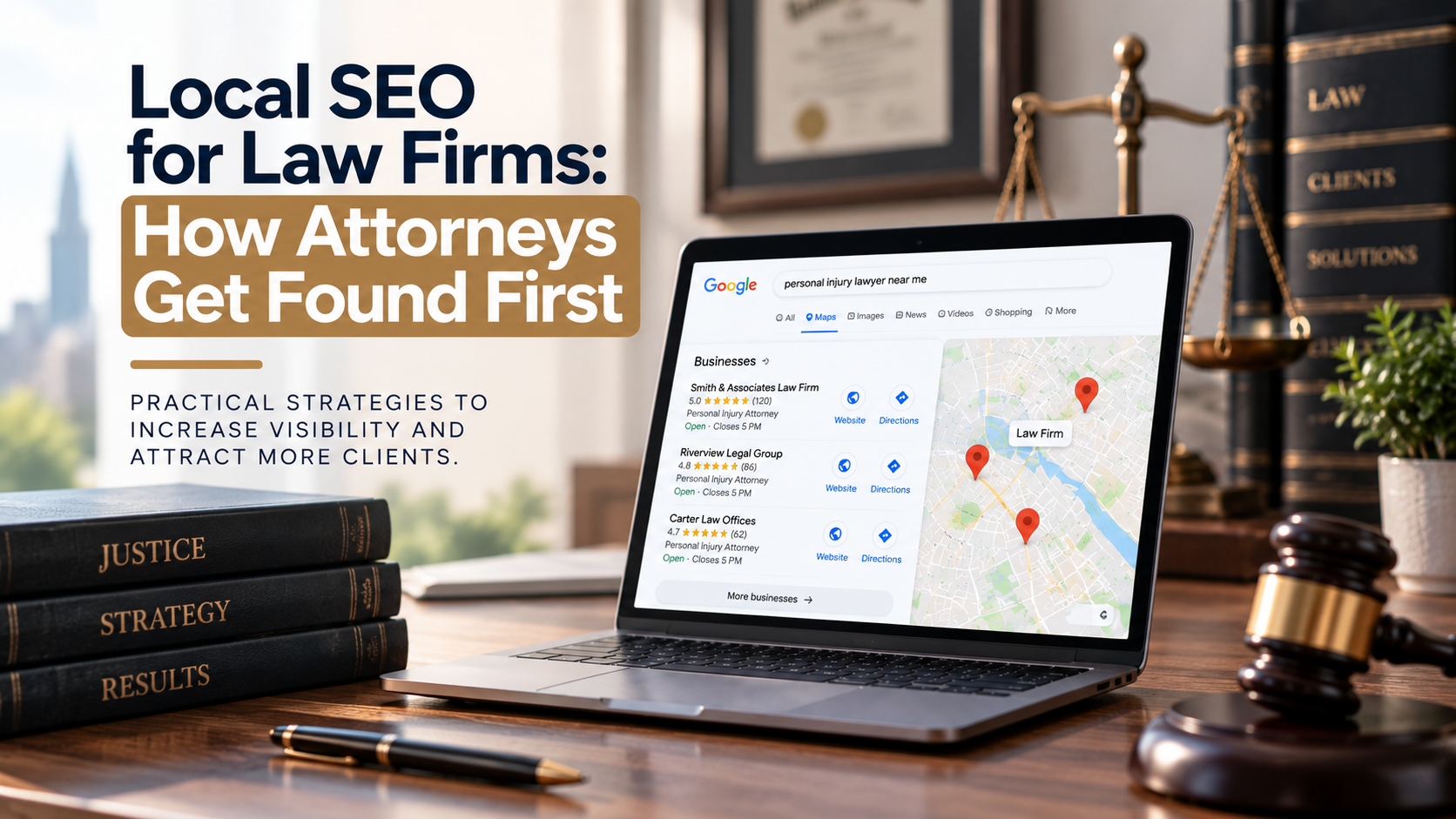
Local SEO for law firms means optimizing your online presence so that people searching for an attorney in your area find you first, before they find a competitor. It works through a combination of your Google Business Profile, your website’s content, and signals that tell Google you are a credible, location-specific legal practice. Done right, it puts your firm in the map pack at the top of search results, right when a potential client has a real legal problem and is ready to call.
For solo attorneys and small firms, this matters more than almost any other form of marketing. You are not competing with national brands on billboards or TV. You are competing with the three other family law or criminal defense or estate planning attorneys who show up on the first screen when someone types “divorce lawyer near me” into their phone. The ones who rank there get the calls. The rest get nothing.
Why Search Intent Is Different for Legal Clients
People searching for a lawyer are not browsing. They have a specific situation, often urgent, and they want to find someone local and trustworthy quickly. That changes how attorney local search works compared to, say, someone shopping for a restaurant or a new pair of shoes.
A few patterns worth knowing:
- Practice-area searches dominate. People search “criminal defense attorney [city]” or “estate planning lawyer near me,” not just “attorney.” Your site needs to speak directly to the specific area of law you handle.
- Trust signals matter more in legal search than almost any other industry. Reviews, years in practice, and professional credentials all factor into whether someone clicks your listing or scrolls past it.
- Mobile and voice search are disproportionately common. Someone who just got a traffic stop or received a legal notice is pulling out their phone immediately. Your listing has to look sharp on mobile.
- Geographic radius is tighter. Most legal clients want someone within a reasonable drive, often within 15 to 30 miles. Hyperlocal signals help you rank for those nearby searches.
Understanding this helps you see why generic SEO tactics built for e-commerce or broad national audiences do not transfer well to legal marketing. You need a strategy built around how people actually look for legal help.
The 5 Things That Drive Local SEO for Law Firms
1. Your Google Business Profile Has to Be Complete and Practice-Specific
Your law firm Google Business Profile is often the first thing a potential client sees. It shows up in the map pack above most organic results. If it is incomplete, has the wrong category, or has not been updated in years, you are leaving visibility on the table.
Set your primary category to match your main practice area as specifically as Google allows. A personal injury firm should not just be listed as “Law Firm” if “Personal Injury Attorney” is available. Add your service areas, list your individual practice areas in the services section, and upload real photos of your office and team. This is one of the clearest factors in how Google decides which attorneys to show for a given search. For a deeper look at how categories affect your ranking, read our breakdown of what your Google Business Profile category actually does.
2. Build Separate Pages for Each Practice Area
One of the most common mistakes small law firms make is putting everything on a single homepage or a single “Our Services” page. Google cannot rank you for “estate planning attorney” and “business litigation attorney” with the same page. It does not work that way.
Practice area SEO means giving each area of law its own dedicated page with relevant content, local references, and the right keywords used naturally throughout. If you handle DUI defense, family law, and civil litigation, each of those needs its own page. Those pages also need to mention your city or service area, not just the legal topic. “Family law attorney in Stroudsburg, PA” ranks for local searches. “Family law” alone does not.
3. Earn Reviews the Right Way
Google weighs reviews heavily in local rankings, and for law firms, they carry extra weight in the client’s decision to call. The challenge is that legal clients are often going through something difficult and may not volunteer a review without a nudge. They also may feel sensitive about publicly identifying themselves as someone who needed a lawyer.
A few things that work: send a follow-up email after a matter closes with a direct link to your Google review page. Keep the ask simple and low-pressure. Do not offer incentives (this violates Google’s terms and most bar association rules). And respond to every review you receive, positive or negative, professionally. That response shows up publicly and signals to potential clients how you handle people.
Check the resources published by the Legal Marketing Association for current guidance on ethical marketing practices specific to law firms. They cover review strategy, advertising compliance, and digital marketing standards in depth.
4. Citations and Directory Listings Still Matter
A citation is any place online where your firm’s name, address, and phone number appear. Avvo, Justia, FindLaw, Martindale-Hubbell, and the state bar directory are all important for legal marketing for small firms. Inconsistencies across these listings, a different phone number here, an old address there, confuse Google and can suppress your local rankings.
Audit your listings regularly and make sure they all match your Google Business Profile exactly. If you moved offices or changed your phone number at any point, there is a good chance old information is still live somewhere and working against you.
5. Your Website Has to Load Fast and Convert Visitors
Local SEO for law firms does not stop at getting someone to click your listing. If your website loads slowly, looks outdated on mobile, or buries your phone number under three paragraphs of legal biography, you will lose the lead before they ever contact you.
A well-structured attorney website should make one thing obvious within the first three seconds: what you do, who you serve, and how to get in touch. Your phone number should be visible at the top of every page. Your practice area pages should each have a clear call to action. And your site should load in under three seconds on a mobile connection. These are baseline expectations now, not extras.
What About Paid Ads and Legal Directories?
Paid search and directory advertising can work alongside local SEO for law firms, but they should not replace it. Ads stop the moment you stop paying. Organic and local search rankings, once built through consistent SEO work, continue to generate leads without a per-click cost. Directories like Avvo can send some traffic, but they also compete with your own website in search results, which is a reason to invest in your own site’s authority rather than depending entirely on third-party platforms.
The attorneys who get the most leads over time are the ones who show up in the map pack organically, have a clean and fast website, and have built a review profile that actually reflects their client experience. That combination takes some work to build, but it compounds over time in a way that ad spend alone cannot replicate.
How to Choose the Right SEO Partner for Your Firm
If you are evaluating outside help, the criteria matter. Look for a marketing partner who understands the professional advertising rules that govern attorney marketing in your state. Claims that guarantee case outcomes or promise you will be “the top attorney in [city]” are red flags, both legally and practically. A good SEO firm will be honest about what is achievable and will focus on sustainable visibility rather than shortcuts.
Our local SEO services for small and professional service businesses are built around the same principles: clear strategy, no inflated promises, and results you can actually measure. If you want to see where your firm stands right now, a free local SEO audit is a straightforward starting point.
Local SEO for law firms is not complicated in theory. You need to be findable for the right searches, in the right locations, with a profile and website that turn visitors into callers. The attorneys who treat that as a consistent, ongoing effort tend to build the kind of local presence that makes word-of-mouth and digital search work together rather than in isolation.
Frequently Asked Questions
How long does it take for local SEO for law firms to show results?
Most law firms start seeing measurable movement in local rankings within three to six months of consistent SEO work. Competitive markets or practices with very little existing online presence may take closer to nine to twelve months to rank well in the map pack. The timeline depends on how well-established your competitors are and how much ground work needs to be done on your site and profile.
Can attorneys legally promote their services through SEO?
Yes, but with important limits. SEO itself is not restricted, but the content on your site and in your listings must comply with your state bar’s advertising rules. Most states prohibit claims that guarantee specific outcomes, use of certain superlatives without substantiation, and testimonials that imply a particular result. A good marketing partner will help you stay within those guidelines while still presenting your firm compellingly.
Should a law firm use the same website page for multiple practice areas?
No. Each practice area should have its own dedicated page. Google can only rank one page at a time for a specific search term, so combining family law and estate planning or criminal defense and DUI on one page splits your ability to rank for any of those searches. Separate pages also give you space to address the specific concerns and questions a client in each situation would have.
What is the most important factor in law firm local search rankings?
Your Google Business Profile is the single most important factor for map pack visibility. That means having a complete, accurate, and category-specific profile with active reviews. Beyond that, your website’s location-relevant content and the consistency of your name, address, and phone number across directories are the next biggest drivers.
Do online reviews actually affect a law firm's search rankings?
Yes, directly. Google uses review quantity, recency, and rating as ranking signals for local search. For law firms, reviews also carry significant weight in the conversion decision, meaning whether someone chooses to call you after they find you. A profile with more recent and detailed reviews consistently outperforms one with fewer or older reviews, even when other factors are similar.