Key Takeaways
- Google Ads deliver calls quickly but stop the moment your budget stops. SEO builds a lead source that keeps generating traffic without a cost-per-click.
- Newer HVAC companies and those entering new markets usually need paid ads first, because they have no organic footprint to build on yet.
- Running both channels in parallel is not about doubling your budget. It means using ad revenue to fund the business while SEO builds the long-term cost structure.
- Your cost per booked job is the number that matters most. Track it separately for paid and organic so you know where to move dollars as your visibility grows.
- Seasonal search patterns should directly affect your HVAC marketing budget. Spending the same flat amount every month ignores the fact that consumer demand, and click costs, shift dramatically by season.
Table of Contents
- What HVAC Google Ads Actually Buy You
- What Local SEO for HVAC Actually Delivers
- HVAC Google Ads vs SEO: The 5 Factors That Should Drive Your Decision
- The Honest Answer: Most HVAC Companies Should Do Both, in Order
- A Few Practical Notes on Running Both Channels
- What We Recommend for HVAC Google Ads vs SEO
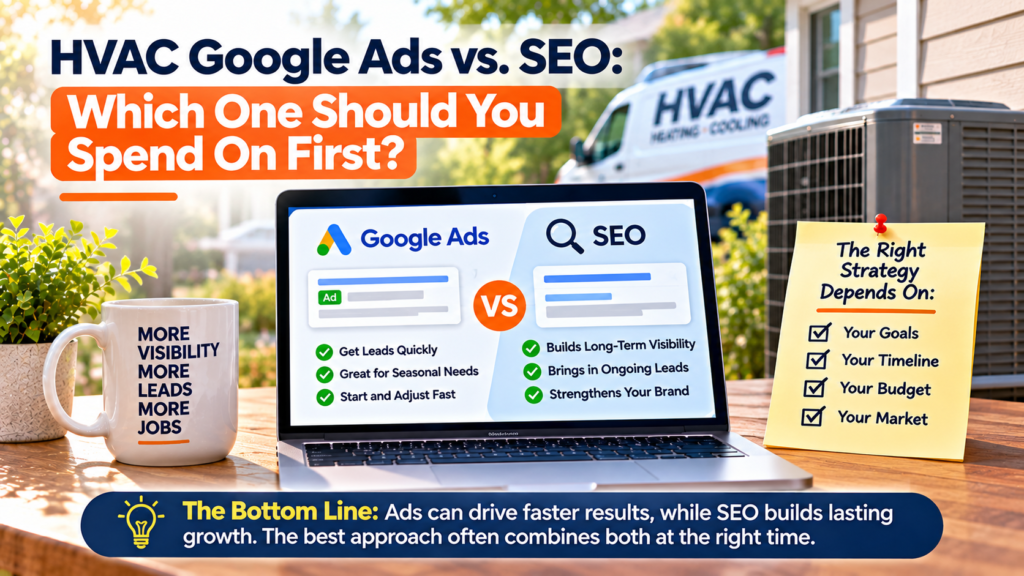
When comparing HVAC Google Ads vs SEO, the honest answer is this: paid ads get your phone ringing this week, while SEO builds a pipeline that costs you less per call over time. Neither one is wrong. The question is which one fits where your business is right now, and whether you are throwing money at the wrong channel for your situation.
Most HVAC owners ask this question after an uncomfortable conversation with a marketing vendor pushing one or the other. The pitch for ads is always urgency. The pitch for SEO is always long-term. Both pitches are self-serving. What actually matters is your current call volume, your cash position, how competitive your market is, and how stable your rankings already are. This article walks through each factor plainly so you can make the call yourself.
What HVAC Google Ads Actually Buy You
HVAC paid search puts your business at the top of Google results within days of launching a campaign. You pay each time someone clicks your ad. On competitive searches like “AC repair near me” or “emergency furnace replacement,” those clicks can cost anywhere from $8 to $30 or more depending on your market and time of year.
What you get for that spend:
- Immediate visibility, even in a market where you have no organic rankings
- Control over which zip codes, hours, and services trigger your ads
- Call tracking data that shows exactly which keywords drove a booked job
- The ability to scale up spending during peak demand and pull back in slow months
What you do not get: any lasting return once the budget stops. Turn off the campaign and the calls stop the same day. That is not a criticism of ads. It is just the structure of the channel, and you should plan around it.
For a newer HVAC company with no organic footprint, or for a contractor entering a new service area, paid search is often the right first move. You need calls to build revenue, and revenue funds everything else.
What Local SEO for HVAC Actually Delivers
Local SEO for HVAC works differently. You are building signals that tell Google your business is the right match for a searcher in your area. That includes your Google Business Profile, your website’s relevance to specific services, reviews, backlinks from local sources, and consistent business information across directories.
The result, when SEO is done properly, is that your business shows up in the map pack and organic results without paying per click. A call that comes through organic search costs you nothing in direct ad spend. Over 12 to 18 months, a well-optimized local presence can generate significantly cheaper leads than a sustained paid campaign, because the cost is mostly fixed work already done rather than ongoing spend.
The tradeoff is time. Solid HVAC Google Ads vs SEO comparisons always come back to this: SEO takes months to move, and it takes real effort to maintain. Google ranks businesses based on relevance, proximity, and authority. You cannot shortcut your way to authority in a competitive market in two weeks.
If your business already has some organic traction, meaning you show up for a handful of searches but not the high-volume ones, SEO spending is usually the smarter use of your next marketing dollar. You are building on existing momentum rather than starting from scratch.
HVAC Google Ads vs SEO: The 5 Factors That Should Drive Your Decision
Rather than picking a side in the abstract, run your situation against these five factors. The answer usually becomes obvious.
1. How Long Have You Been in Business?
A company in its first one to two years almost always needs paid ads first. You have no review history, weak domain authority, and no established local signals. SEO will eventually work, but you cannot wait 12 months for it. Run ads while you build the SEO foundation underneath.
2. What Is Your Current Call Volume?
If your phone is already ringing from organic or referral traffic, SEO investment compounds that. If your phone is quiet, ads fill the gap faster. This is a cash flow question as much as a marketing question.
3. How Competitive Is Your Service Area?
In rural or suburban markets with limited competition, local SEO often works faster and costs less. In dense metro areas with dozens of well-funded competitors, ranking organically for high-intent searches takes longer and requires more sustained work. Paid ads can help you compete immediately while the SEO builds.
4. What Are Your Margin and Ticket Sizes?
A $25 click that converts to a $4,000 system replacement is a different math problem than a $25 click that converts to a $95 tune-up. If your average job value is high, paid ads remain profitable even at premium click costs. If your average ticket is low, the economics get tighter fast, and SEO’s lower cost-per-lead over time matters more.
5. Do You Have the Infrastructure to Handle More Calls?
This one gets skipped constantly. Ads can generate phone volume quickly, but if your front office is missing calls or booking poorly, you are burning money. Make sure your call handling is solid before scaling any paid channel. SEO’s slower ramp actually helps here because it gives you time to tighten your operations.
The Honest Answer: Most HVAC Companies Should Do Both, in Order
The real answer to the HVAC Google Ads vs SEO debate is not an either/or. It is a sequencing question. For most HVAC businesses, the right move is to run a focused, well-targeted paid campaign to generate near-term revenue while investing steadily in local SEO to reduce your cost per lead over time.
The mistake most owners make is dumping everything into ads indefinitely because the results are visible and fast, then wondering why their marketing costs never go down. Paid search is a great tool. It is a terrible strategy on its own if you never build organic visibility alongside it.
The Air Conditioning Contractors of America (ACCA) has noted that consumer trust in HVAC contractors is directly tied to how they are perceived online, including reviews, credentials, and visibility. Organic search results and your Google Business Profile are where that trust gets built before someone ever picks up the phone.
If you are weighing how to split your HVAC marketing budget, a reasonable starting framework for a growth-stage contractor is to run paid ads while devoting at least an equal portion of your marketing spend to building long-term local SEO. That ratio shifts over time as your organic rankings take hold. Eventually, many contractors can reduce paid spend significantly because organic and map pack traffic handles a large share of call volume on its own.
For a deeper look at how seasonal search patterns should factor into your decisions, the article on Pocono HVAC search rankings by season is worth reading. Search volume for HVAC services shifts dramatically by month, and your ad and SEO budgets should shift with it, not stay flat year-round.
A Few Practical Notes on Running Both Channels
Running HVAC Google Ads and SEO together does not mean doubling your marketing bill. It means being intentional about where each dollar goes and what it is supposed to accomplish.
- Use ad campaign data to find which service searches convert best, then build SEO content targeting those same searches
- Do not compete against yourself. If you rank organically on page one for a term, you may not need to pay for that same click
- Build your Google Business Profile seriously. It is the single highest-leverage local SEO asset for HVAC companies and it costs nothing but time
- Review generation is not optional. A business with 12 reviews will lose map pack position to a competitor with 80, even if every other signal is equal
- Track both channels separately. Know your cost per booked call from ads and from organic. That number tells you where to move dollars next
If you want help figuring out where your current local SEO stands before committing more budget to ads, our team offers a free local SEO audit that shows exactly where your business sits in search for your actual service area.
What We Recommend for HVAC Google Ads vs SEO
Our position, based on working with home service contractors: if you are under two years old or entering a new market, start with ads and build SEO in parallel. If you have been operating for a while and still have no organic visibility, you are leaving long-term money on the table every month. If your organic presence is decent but inconsistent, targeted SEO work will likely outperform the same dollars spent on ads.
The contractors who win long-term are the ones who treat ads as a revenue bridge and SEO as infrastructure. Neither one replaces the other. If you are specifically in the Pocono area or nearby markets, our HVAC marketing for the Pocono region covers how local search behavior specifically affects contractors here, including the seasonal peaks that make timing your visibility critical.
The right channel is the one that fits your stage, your market, and your ability to handle the volume it generates. Start there. Build from it.
Frequently Asked Questions
How quickly can HVAC Google Ads generate leads?
A properly set up Google Ads campaign can start generating clicks and calls within a day or two of going live. Most HVAC contractors see meaningful call volume within the first week if their targeting, budget, and landing page are in order. The tradeoff is that leads stop immediately when the budget runs out.
How long does local SEO take for an HVAC company?
In moderately competitive markets, a well-executed local SEO effort typically shows measurable ranking improvements within 3 to 6 months and meaningful call volume growth within 9 to 12 months. Highly competitive metro areas take longer. Rural and suburban markets can move faster, sometimes inside 90 days for specific service searches.
Can I run Google Ads and SEO at the same time?
Yes, and for most growth-stage HVAC companies this is the right approach. Ads generate near-term revenue while SEO builds the organic foundation that reduces your cost per lead over time. Running both is not about doubling your budget. It is about allocating spend intentionally toward different goals on different timelines.
What does HVAC Google Ads cost per click?
Click costs vary by market, season, and search term. Emergency and replacement-focused searches tend to cost more than tune-up or maintenance searches. A reasonable planning range for competitive HVAC markets is $10 to $30 per click, though some markets run higher. What matters most is your cost per booked job, not your cost per click.
Is SEO worth it for a small HVAC company?
Yes, especially over a 12- to 24-month horizon. Small HVAC companies often compete more effectively in local search than they do in paid search, where larger companies can outspend them. A focused local SEO strategy, including a well-managed Google Business Profile and consistent reviews, can generate leads at a significantly lower cost per call than sustained paid advertising.