Key Takeaways
- Google Business Profile reviews are a real ranking signal, not just reputation management. Review count, recency, and owner response rate all influence where your business appears in local search results.
- Review recency matters as much as total volume. A business that collects a steady flow of new reviews each month will typically outperform one that has more total reviews but stopped earning new ones years ago.
- Responding to every review, including negative ones, tells Google your profile is active and managed, which supports better local rankings over time.
- Asking every satisfied customer for a review through a direct link is allowed by Google and is one of the highest-return, lowest-cost actions a local business can take for SEO.
- A sudden spike of reviews in a short window can look suspicious to Google and risk getting them filtered out. A consistent, ongoing asking process beats a one-time push every time.
Table of Contents
Google Business Profile reviews directly affect where your business appears in local search results. Google treats review count, review recency, and how you respond to reviews as active ranking signals, not just social proof for shoppers. If your competitors have more reviews, newer reviews, or better response habits than you do, they will often outrank you in the map pack, even if your business is closer to the searcher.
That is not a guess or a marketing pitch. It is a documented part of how Google evaluates local businesses. Understanding the mechanics behind it gives you a real advantage, because most business owners either ignore this entirely or think posting a one-time request is enough.
Why Google Uses Reviews as a Ranking Signal
Google’s goal in local search is to surface the business most likely to satisfy the person searching. Reviews give Google a stream of real-world feedback about your business from people who actually showed up. A business with 150 reviews that average 4.7 stars, spread consistently over the past two years, tells Google something very different than a business with 12 reviews from three years ago.
Google looks at reviews through three lenses:
- Volume: How many reviews does your profile have total? More is generally better, but only alongside quality.
- Recency: When were your most recent reviews left? A surge of old reviews with nothing new signals stagnation to Google.
- Sentiment and keywords: What words do reviewers actually use? Reviews that mention your service type or location (“best plumber in Stroudsburg,” “fast HVAC repair”) add context Google can read.
For a deeper look at the full framework Google applies to map pack results, this breakdown of Google’s local map pack ranking factors covers where reviews fit alongside other signals like proximity and relevance.
How Google Business Profile Reviews Influence the Map Pack
The map pack, those three business listings that appear at the top of a local search, is competitive real estate. Google considers dozens of signals, but reviews are one of the most actionable ones because you can actually influence them week to week. Most of the other ranking factors, like your physical address or how your website is structured, take longer to change.
Here is what the review-to-ranking relationship actually looks like in practice:
Review Count Compared to Competitors
If you search for your service category in your city and pull up the businesses in the top three map pack positions, check their review counts. In most mid-sized local markets, the businesses ranking consistently in those spots have significantly more reviews than the ones stuck on page two. This is not coincidence. Google interprets a higher volume of reviews as a signal that more people have experienced and vouched for that business.
Recency Matters More Than Most Owners Realize
Google Business Profile reviews carry more weight when they are recent. A business that collected 80 reviews two years ago and has added almost none since is essentially telling Google it has slowed down or stopped being active. A business that collects five to ten reviews per month, even with a slightly lower average star rating, often outperforms the stagnant one because the ongoing activity signals a healthy, operating business.
This is one reason why a single review push, where you ask your whole customer list at once and then forget about it, gives you a short spike but no lasting lift. The strategy that actually works is building a lightweight, repeatable process for asking every satisfied customer.
Your Response Rate Is Also Being Watched
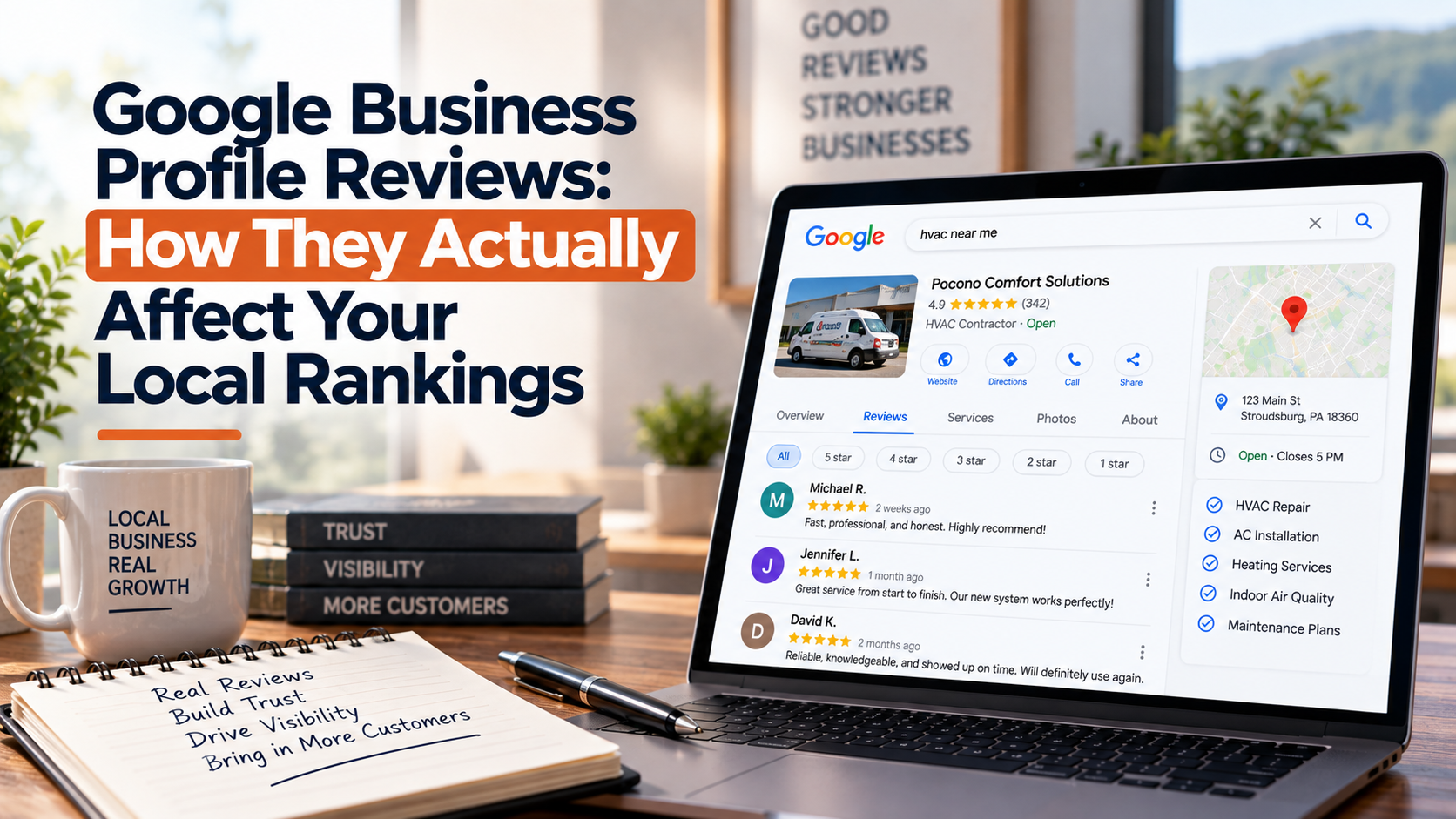
Responding to reviews is a ranking signal many small business owners overlook entirely. Google has confirmed that responding to reviews is a best practice that can improve local search visibility. The logic makes sense: a business owner who replies to feedback is demonstrably engaged, which correlates with an active, customer-focused business.
This does not mean you need to write an essay for every five-star review. A short, genuine reply that uses the reviewer’s name and mentions a specific detail about their experience is enough. What you want to avoid is leaving reviews completely unanswered, especially negative ones. A thoughtful response to a bad review often matters more than the review itself in terms of both rankings and reputation.
What Kinds of Reviews Help the Most
Not all Google Business Profile reviews carry equal weight. Here is a practical hierarchy:
- Detailed reviews with relevant keywords: A review that says “Great service” is fine. A review that says “Called them for an emergency furnace repair on a Sunday and they showed up within two hours” is significantly more useful to Google and to future customers reading it.
- Reviews from active Google accounts: Google can tell the difference between a review from someone who has reviewed dozens of places and a brand-new account that exists solely to leave one review. Authentic accounts carry more weight.
- Reviews with photos: When customers attach photos to their reviews, it adds a layer of credibility that Google values, especially in service categories where showing before-and-after or the finished work is meaningful.
- Reviews that mention location: If someone mentions your city or neighborhood in a review, that is useful geographic context that reinforces your relevance for searches in that area.
How to Ethically Get More Google Business Profile Reviews
Google’s terms prohibit incentivizing reviews, meaning you cannot offer discounts, gifts, or cash in exchange for them. That said, simply asking satisfied customers is both allowed and effective. Most customers who had a good experience are genuinely willing to leave a review. They just need a nudge and an easy path to do it.
A few approaches that work well for local service businesses:
- Send a follow-up text or email within 24 hours of completing a job with a direct link to your Google review page.
- Train your team to mention reviews at the end of a job: “If we did a good job today, a quick Google review really helps us out.”
- Add your review link to invoices, receipts, and email signatures.
- For businesses with physical locations, a small sign near the register or exit with a QR code gets consistent results without any extra staff effort.
For service businesses like HVAC and plumbing companies where reviews can make or break whether a new customer even calls, this is one of the highest-return actions you can take. HVAC and plumbing SEO has its own specific patterns worth understanding too, and reviews sit at the center of both.
Common Mistakes That Hurt Your Review Rankings
Even businesses that are actively collecting Google Business Profile reviews often undercut themselves with a few common habits:
- Asking only happy customers: Cherry-picking who you ask skews your profile, but it also means you are not learning from customers who had a neutral or mixed experience. Balance is better long term.
- Batch-asking all at once: A sudden spike of reviews in a short window can look suspicious to Google and may result in some of them being filtered out.
- Never responding: As covered above, no responses signals low engagement. Even a brief, honest reply helps.
- Ignoring negative reviews: A professional response that acknowledges the issue and offers to make it right does more for your reputation and rankings than leaving a one-star review to sit unanswered.
- Using a third-party review gating tool: Some services only forward customers who rate you highly to Google while filtering out those who do not. Google considers this a policy violation and can penalize your profile.
Where to Go From Here
If you are not sure how your review profile compares to competitors in your market, the first step is an honest look at what you have now. How many reviews do you have? When was the last one left? What are your closest competitors showing? Those three data points tell you a lot about what kind of ground you need to make up.
For more on how Google weighs all the pieces of local search together, Moz’s guide to local SEO is one of the more reliable plain-English overviews of how the system works as a whole.
If you want a clearer picture of exactly where your profile stands, including your reviews, your category setup, and how well your overall profile compares to what Google is looking for, a free local SEO audit is a good starting point. There is no commitment involved and it gives you specific, actionable information rather than a generic score.
Reviews are one of the few local search ranking factors you can actually move in a matter of weeks with consistent effort. They do not require a technical background or a big budget. They require a simple system and the habit of asking. For most local businesses, that is entirely within reach.
Frequently Asked Questions
Do Google reviews directly affect local search rankings?
Yes. Google uses review count, recency, and response behavior as signals when deciding which businesses to show in local search results and the map pack. More recent reviews from active accounts, combined with regular owner responses, tend to improve ranking performance over time.
How many Google reviews do I need to rank in the map pack?
There is no fixed number. What matters more is how your review count compares to the competitors already ranking in your area for your service category. In some markets, 30 reviews might be competitive. In others, 150 is the baseline. Search your category locally and see where you stand relative to the top three results.
Can I ask customers to leave me a Google review?
Yes, and you should. Google allows businesses to ask customers for reviews. What is not allowed is offering anything in exchange, like a discount or a gift card. Simply sending a follow-up message with a direct link to your review page is both effective and within Google’s terms of service.
Should I respond to negative reviews on Google?
Absolutely. Responding professionally to a negative review signals to both Google and potential customers that you are engaged and take feedback seriously. A calm, constructive response that acknowledges the issue and offers to resolve it often does more for your reputation than the negative review does against it.
Do keywords in customer reviews actually help with SEO?
Yes, they can. When reviewers naturally mention your service type, location, or specific work they had done, Google can read that content and use it to better understand what your business does and where it serves people. You cannot control what reviewers write, but providing great service in specific areas tends to produce reviews that organically include those details.