
Key Takeaways
- Google ranks local businesses based on verifiable trust signals, not reputation or years in business. We've watched newer competitors with better signals outrank companies that do better work, and it catches owners off guard every time.
- NAP consistency, meaning your business name, address, and phone number matching exactly across every directory and listing, is foundational. It's the first thing we check on a new account, because inconsistencies quietly damage map pack rankings over time.
- Reviews need to be recent and responded to, not just numerous. In our experience, a slow drip of real reviews with owner responses carries more weight than a burst of old ones with no engagement.
- Your website and your Google Business Profile work together. Location-specific content on your site reinforces the credibility of your profile, and when we see a profile that's stuck, a neglected website is often the reason.
- Most local business trust problems are fixable without a large budget. We usually start clients with an NAP audit, a fully completed profile, and a system for collecting reviews consistently.
Table of Contents
Google Trusts Some Local Businesses More than others. Local business trust is the reason one plumber in your town shows up in the map pack every single time, even if you’ve been open longer and do better work. Google doesn’t know your reputation from word of mouth. It can only rank what it can verify. If you haven’t given it verifiable signals that your business is real, established, and relevant, it defaults to whoever has.
This isn’t about gaming the system. It’s about understanding what Google actually uses as evidence that a business deserves to rank. Once you see the list, most of it is common sense. The frustrating part is that a lot of business owners have never been told what the list even is.
What “Trust” Actually Means to Google
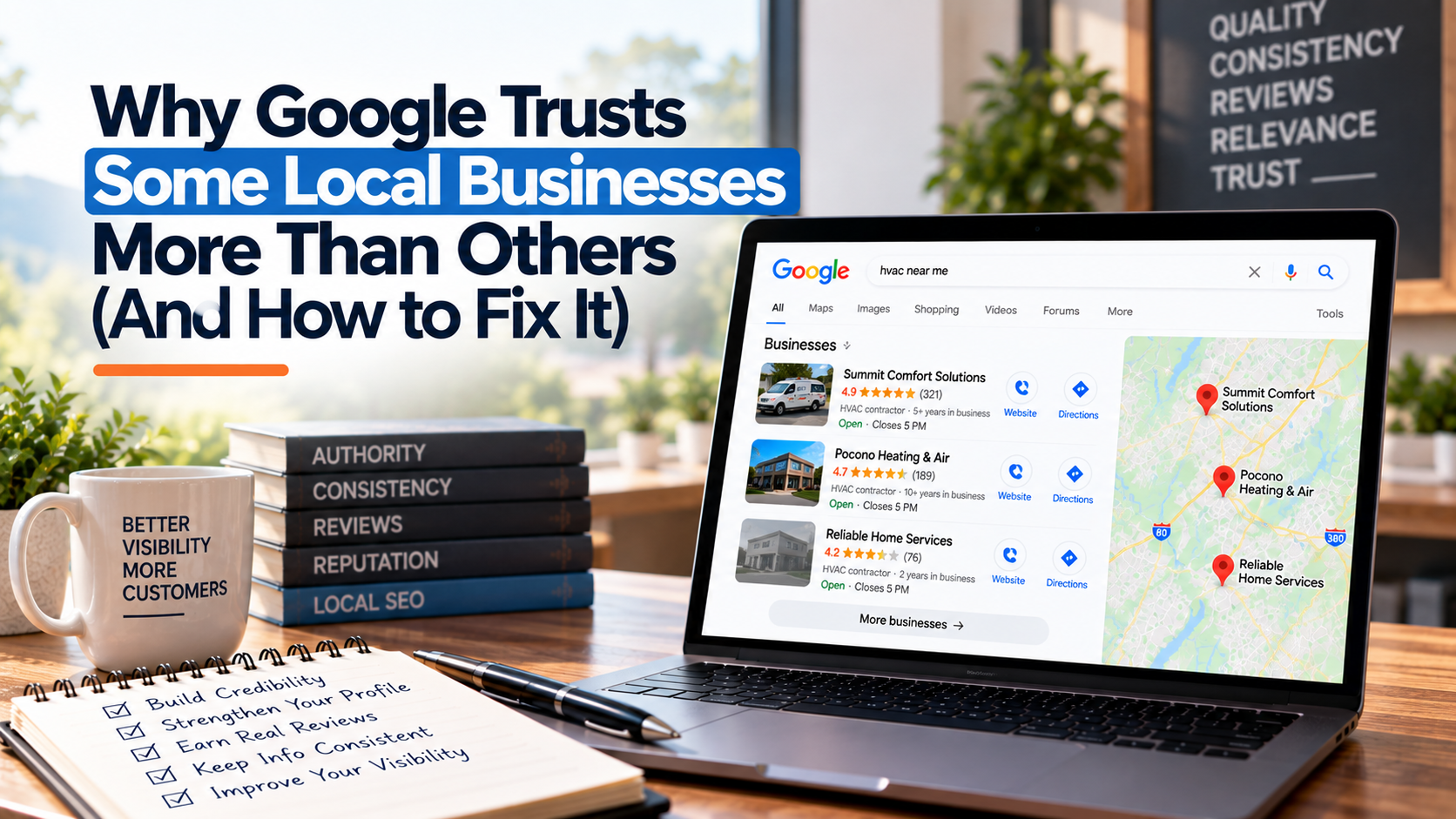
Google uses the word “prominence” in its own documentation, but trust is a cleaner way to think about it. When Google is deciding which three businesses to show in the map pack for a search like “HVAC repair near me,” it’s asking: which of these businesses has the most consistent, verifiable evidence that it exists, operates where it says it does, and does what it says it does?
That evidence comes from signals across the web, not just from your Google Business Profile. And that’s where most small businesses fall short. They set up a profile, fill in the basics, and assume the work is done. It’s not.
For a deeper look at what Google weighs specifically inside the map pack, this breakdown of Google’s local map pack ranking factors is worth reading alongside this article.
The 5 Local Business Trust Signals Google Can Actually Verify
1. Name, Address, and Phone Consistency Across the Web
If your business name appears as “Smith Plumbing” on your website, “Smith Plumbing LLC” on Yelp, and “Smith’s Plumbing Services” on a local directory, Google sees three different entities, not one. That inconsistency quietly erodes local business trust, because Google can’t confidently match those listings to a single verified location.
This is called NAP consistency, and it matters more than most people expect. A mismatched suite number, an old phone number still sitting on a directory, or a name variation you used years ago can all dilute the signal. The fix is an audit of every directory where your business appears, followed by corrections. It’s tedious, but it’s foundational.
2. Google Business Profile Completeness and Activity
A half-filled profile tells Google your business probably isn’t actively managed. An actively managed profile, one with current hours, real photos, a complete category setup, recent posts, and Q&A responses, signals that a real business owner is paying attention.
Google rewards recency. A profile that was set up three years ago and never touched again carries less weight than one that shows regular activity. You don’t need to post daily. But a monthly update, a new photo, or a response to a recent review is enough to signal that the lights are on.
The specific attributes you select inside your Google Business Profile also do more than most people realize. Here’s what Google Business Profile attributes actually do for your local rankings, explained without the jargon.
3. Reviews: Volume, Recency, and Response Rate
Reviews are one of the clearest local business trust signals Google has. Not just because customers read them (they do), but because Google uses them as evidence that real transactions are happening at a real location.
A business with 80 reviews spread over two years looks more credible than one with 80 reviews all posted in a single month. Recency matters too. A business whose last review was 14 months ago doesn’t look actively operated. And when you respond to reviews, especially negative ones, you demonstrate accountability that both customers and Google notice.
The volume threshold that “matters” varies by market and category. In a competitive urban market, 80 reviews might barely get you noticed. In a smaller town, 20 solid reviews with responses could put you in the top three. The point is to build steadily and keep the recency alive.
4. Local Citations and Directory Listings
Citations are mentions of your business name, address, and phone number on external websites. Think Yelp, Angi, the Better Business Bureau, local chamber of commerce directories, and industry-specific platforms. Each consistent citation is a small vote of confidence that your business exists where it says it does.
The quality of the citation source matters. A listing on a well-established, real directory like Yelp or your local chamber of commerce site carries more weight than a listing on a spam directory that nobody visits. If you’re in the Pocono region specifically, this guide to Pocono region business directories breaks down which ones actually move the needle.
The goal is not to get listed on 200 directories. It’s to be listed accurately and consistently on the directories that Google already trusts.
5. Your Website’s Local Relevance Signals
Your website and your Google Business Profile aren’t separate strategies. They talk to each other. Google looks at your website to confirm that the business is real, that it serves the area it claims to serve, and that the content matches the category you’ve selected in your profile.
A website with no city or region mentions, no service area content, and a generic homepage that could belong to any business anywhere gives Google almost nothing to work with. Adding location-specific content, embedding a Google Map, using your actual service area in page titles, and having your NAP in the footer are all signals that reinforce local business trust.
This doesn’t mean stuffing your city name into every paragraph. It means writing pages that clearly describe who you serve and where, the way a real local business would naturally do it.
Why the Business That’s “Always Been There” Sometimes Still Loses
One of the most common frustrations we hear from business owners is some version of: “I’ve been in this town for 15 years. Why does that newer company outrank me?”
The answer is usually one of two things. Either the newer business has done a better job building verifiable trust signals in Google’s specific language, or the older business has accumulated inconsistencies over the years (old addresses, outdated phone numbers, neglected profiles) that are actively working against it.
Longevity is not a ranking signal. Digital credibility is. The good news is that digital credibility is buildable, and it doesn’t require a huge budget. It requires consistent attention to the right things.
For a plain-English take on how authoritative sources in the SEO industry track these ranking patterns, Search Engine Land (local SEO coverage) is one of the more reliable places to follow ongoing changes without wading through hype.
How to Start Building Local Business Trust Today
You don’t need to fix everything at once. Here’s a practical order of operations:
- Audit your NAP first. Search your business name and phone number and see what comes up. Look for inconsistencies and correct them one listing at a time.
- Complete your Google Business Profile. Fill every section. Add real photos. Select the most specific category that fits your business. Set your hours accurately, including holiday hours.
- Build a review habit. Ask every satisfied customer for a review. Make it easy by sending a direct link. Respond to every review, good or bad, within a week.
- Get listed on the right directories. Focus on quality over quantity. Yelp, your local chamber, the BBB, and any industry-specific platform relevant to your trade are good starting points.
- Update your website’s local signals. Add your city and service area to your homepage title, your footer, and at least one dedicated service area page.
None of these steps are technically complicated. The hard part is doing them consistently and correctly, especially the NAP audit, which can take several hours the first time through.
What This Looks Like in Practice
Imagine two electricians serving the same town. Electrician A has been in business for 12 years, has a basic Google Business Profile with 9 reviews, and hasn’t updated their listing since 2021. Their website has no city-specific content.
Electrician B opened 18 months ago. They have 34 reviews with owner responses, a fully completed profile with recent posts and photos, accurate directory listings, and a website that specifically mentions the towns they serve.
Google is going to show Electrician B. Not because they’re better at electrical work, but because they’ve built more verifiable local business trust. From Google’s perspective, Electrician B looks like the real, active, engaged business in this market.
This is a solvable problem for Electrician A. But it requires acknowledging that longevity alone doesn’t translate into digital credibility.
Getting Outside Help Without Overpaying
If you want to understand what this work actually costs before committing to anything, we publish our transparent SEO pricing directly on our site so you can see what’s included and make a real comparison. No discovery call required to get a ballpark.
Local business trust is built over time, but it starts with knowing what Google is actually looking for. Most businesses are closer than they think. They just need someone to point at the right things in the right order.
Common questions every business owner needs to ask
How long does it take to build local business trust with Google?
It depends on how much ground you need to cover. In our experience, cleaning up NAP inconsistencies and filling out a Google Business Profile is where the first movement shows up, often somewhere in the 4 to 8 week range. Not every time, though. We’ve had accounts respond in under a month and others sit quiet for three, usually because the market was crowded or the listing had years of bad data behind it. Reviews and citation authority take longer. Most of the businesses we’ve worked with needed 3 to 6 months before their map pack rankings held steady instead of bouncing around. We can’t guarantee a timeline, and we’d be wary of anyone who does. What we can tell you is that the shortcuts we’ve seen people try never lasted.
Does having more Google reviews automatically mean a higher ranking?
Reviews are one signal among several, not the only one. We’ve seen businesses with 200 reviews lose to a competitor sitting at 40, and it usually comes down to the same things: a neglected profile, inconsistent NAP data, a website that isn’t pulling its weight. That surprises a lot of the owners we talk to. Volume and recency matter, and we push our clients to keep both moving, but reviews work together with the other trust factors. They don’t carry a listing on their own. When we audit an account, reviews are one of the things we check, never the only thing.
Can old or incorrect directory listings hurt my local rankings?
Yes. Inconsistent listings confuse Google about which address, phone number, or business name is correct, and that confusion reduces confidence in your listing. It can hold you back in map pack rankings. We run into this constantly, usually with businesses that moved, changed phone numbers, or rebranded years ago and never went back to clean up the old directories. Most owners don’t even know those listings exist. The fix is finding them and correcting or removing each one, which is slow work. We won’t pretend otherwise. It’s also some of the most reliable work we do, because once the data matches everywhere, the listing tends to respond.
Does my website affect my Google Business Profile ranking?
Directly, yes. Google uses your website to confirm that your business is real and relevant to the searches you’re trying to rank for. We see this play out when a profile is fully built out and still stuck, and the website turns out to be the weak link: thin content, no mention of the towns the business serves, an old phone number sitting in the footer. A site with strong local content, accurate NAP, and clear service area pages reinforces the trust signals in your Google Business Profile. That’s why we look at both together. We rarely treat a map pack problem as only a profile problem, because the two lean on each other more than most owners expect.
What’s the single most important thing I can do first if my local rankings are weak?
Start with your Google Business Profile and NAP consistency. That’s where we begin with nearly every new account, because an incomplete or inconsistently listed profile is often the fastest thing to fix and it addresses one of the core signals Google weighs. After that, focus on building a steady flow of recent reviews. Steady is the word that matters. We’d rather see a client earn a few reviews every month than forty in one week and then nothing. Most of the businesses we’ve worked with that had never touched local SEO before saw movement from those two steps alone, though how much depends on the market they’re in.