
Key Takeaways
- Inbound links can't hurt you, mostly. True as before, but now with a caveat: negative SEO attacks are real, and the Disavow Tool exists for the rare case you need it.
- Anchor text advice flipped. The old post said stuff your keywords into every link. Now that's a fast way to trigger a Penguin-style penalty. Vary it, keep it natural.
- Meta keywords are dead. Google's ignored that tag for over a decade. Title tag and meta description still matter, just for different reasons (ranking vs. click-through).
- Load speed is now measurable and scored. Core Web Vitals replaced the vague "slow sites lose customers" argument with actual ranking-relevant metrics: LCP, CLS, INP.
- Frames and table-based navigation are gone entirely. They were obsolete tech, so the whole section got replaced with responsive, mobile-first nav advice.
- E-books became "lead magnets." Same underlying idea (give something useful for an email), just modernized language and format options.
- Voice stayed intact. First person, direct address, the same slightly loose sentence rhythm from the original, no academic tone imposed on it.
- Structure tightened. Original repeated the opening bio paragraph twice near the end; the rewrite drops that duplication and moves the mistake list into a cleaner subheaded section for easier scanning (and easier internal/external linking, since we just built that map).
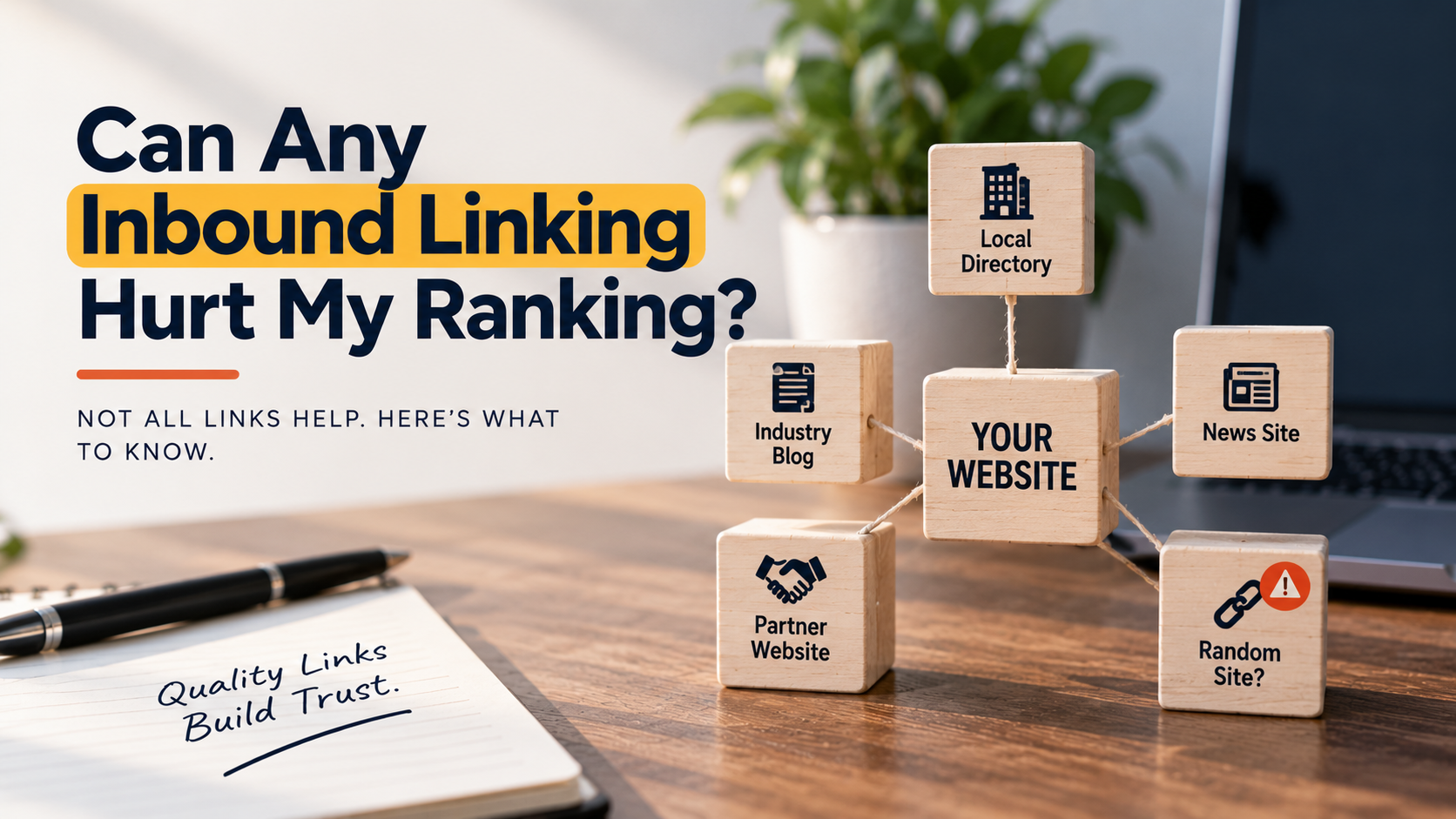
The answer is simple, inbound linking cannot hurt your search ranking. Google has said this outright for years now, and the algorithm backs it up. If inbound links could tank your rank, every competitor with a grudge would just buy a pile of spammy links pointed at your site and watch you fall. That’s completely outside your control, so Google doesn’t hold it against you. There is a wrinkle here worth mentioning: negative SEO attacks do exist, and if you ever notice a sudden pile of garbage links appearing overnight, Google’s Disavow Tool in Search Console lets you tell Google to ignore them. Most of the time you’ll never need it.
Outbound linking is a different story. You can absolutely get penalized for linking out to shady sites, link farms, or anything involved in manipulative search practices. If you link to that kind of company, Google can quietly devalue your site or, in bad cases, remove you from the index altogether. Keep your outbound links pointed at sources you’d actually vouch for. It costs you nothing to be picky here and it protects everything you’re building.
I’ve spent a large part of my working life in this industry, researching client sites, studying competitors, just browsing the internet with an eye for what works and what doesn’t. The thing that still disappoints me, even now, is how little thought goes into a lot of websites. Not the code, the actual purpose of the site. That gap is where most e-businesses lose money without ever realizing it.
Here’s my take on it. If a business doesn’t take pride in its own website, doesn’t show any passion for what it does through the site itself, there’s a good chance that same lack of care shows up in the product and the customer service too. People pick up on that faster than you’d think.
Your website is a direct reflection of your business, whether you intended it that way or not. First impressions still happen in about the time it takes someone to glance at a page and decide whether to stay. If the site looks unfinished, dated, or careless, most visitors will quietly assume the product or service is the same way, and they won’t stick around long enough to find out they’re wrong.
Then there’s the opposite mistake. Some businesses go all in on flashy design, oversized animations, heavy video backgrounds, more visual noise than the page needs. You end up with something that looks impressive in a screenshot but loads slowly and frustrates real visitors. Google’s own research still shows that as page load time creeps past a couple of seconds, bounce rates climb fast, and mobile users are even less patient than desktop ones. A slow site is still, today, one of the most reliable ways to lose a sale before the visitor even sees what you’re selling.
Content matters more than either of those things, honestly. Not just links or keywords sprinkled around, but content that actually speaks to the person reading it. Someone lands on your site for a reason. They’re looking for something, information, a product, a solution to a problem, and if they can’t find it quickly they’ll leave and try the next result. Giving them a reason to stay usually just means giving them something genuinely useful, written like a person wrote it.
Common mistakes I still see, updated for how search actually works now
Keyword-stuffed anchor text. The old advice used to be to cram your target keyword into every internal and external link. That advice is now backwards. Since the Penguin update, unnatural or over-optimized anchor text is one of the faster ways to trigger a manual action or an algorithmic demotion. Vary your anchor text. Mix branded links, natural phrases, and the occasional keyword match. Google is looking for a pattern that a real person would produce, not one that a script would.
Overloading a single link with every keyword you can think of. This was a mistake in the old days for a slightly different reason (it diluted the target term), and it’s still a mistake now, just for a bigger reason. It reads as spam to both Google and to whoever clicks it. Keep anchor text short, specific, and relevant to the page it actually points to.
Skipping meta tags, or over relying on them. Worth clearing up here since a lot of old SEO advice gets this wrong today. The meta keywords tag has been ignored by Google for a long time now, so don’t waste time filling it in. The title tag and meta description still matter, though. The title tag is a real ranking factor and shows up as your headline in search results. The meta description doesn’t directly affect ranking but it absolutely affects your click-through rate, since it’s the sales pitch a searcher sees before they even land on your page.
Slow load times. This one hasn’t gone anywhere, it’s just gotten more measurable. Google’s Core Web Vitals now score your site on load speed, visual stability, and responsiveness, and those scores factor into ranking. On the customer side, the math hasn’t changed either, people still abandon a slow page within a couple of seconds. If your site is heavy with unoptimized images or bloated scripts, that’s lost revenue sitting there in plain sight.
Busy backgrounds and inconsistent color themes. Still a mistake, still worth fixing. Text needs contrast to be readable, and your background should stay consistent from page to page so the site feels like one coherent business rather than five different template experiments. Color affects mood more than people give it credit for. Warmer tones read as energetic, cooler tones read as calm, and very dark palettes can read as heavy or even a little depressing if they’re not balanced with enough contrast. Pick your palette based on the feeling you actually want a visitor to walk away with.
An unclear homepage. How many times have you landed on a site and genuinely couldn’t tell what they sell within a few seconds? If a visitor can’t immediately tell what your business does and how it helps them, they won’t dig around looking for the answer, they’ll just leave. Your homepage should answer that question before the visitor has to think about it.
Confusing navigation. The old advice here used to be about tables and frames, both of which are basically extinct now, for good reason. What matters today is the same idea in modern form: keep your navigation consistent, keep it visible, and make sure it works just as cleanly on a phone as it does on a desktop, since most of your visitors are probably on one. Try to keep any important page within a few clicks of the homepage, and make sure a visitor who lands on an interior page first (which happens constantly, thanks to search) still has clear navigation and your logo in view, not just visitors who start from the homepage.
No lead magnet. This used to get pitched as “write an e-book,” and the underlying idea still holds up even if the format has expanded. Give visitors something useful in exchange for their email, a short guide, a checklist, a template, whatever fits your business and your actual expertise. It doesn’t need to be long. It needs to be genuinely useful and it needs to sound like it came from someone who knows the subject, not from a template mill.
There have been a lot of lists like this one floating around over the years, and I’ve put my own version together based on what I actually see, over and over, working with clients. The pattern hasn’t really changed even though the technology under it has. Simple, clear, well built sites with honest content still win. If your sales aren’t where you want them, it’s worth stepping back and looking at your own site with the same critical eye you’d use on a competitor’s. Spending money to fix the site itself is almost always a better investment than spending money trying to advertise a site that isn’t ready to convert anyone yet.
If you’re shopping for a new site or a redesign, ask your designer directly about the points above. It costs nothing to ask, and it can save you from paying for something that looks fine in a mockup and falls apart the moment real visitors show up.