
Key Takeaways
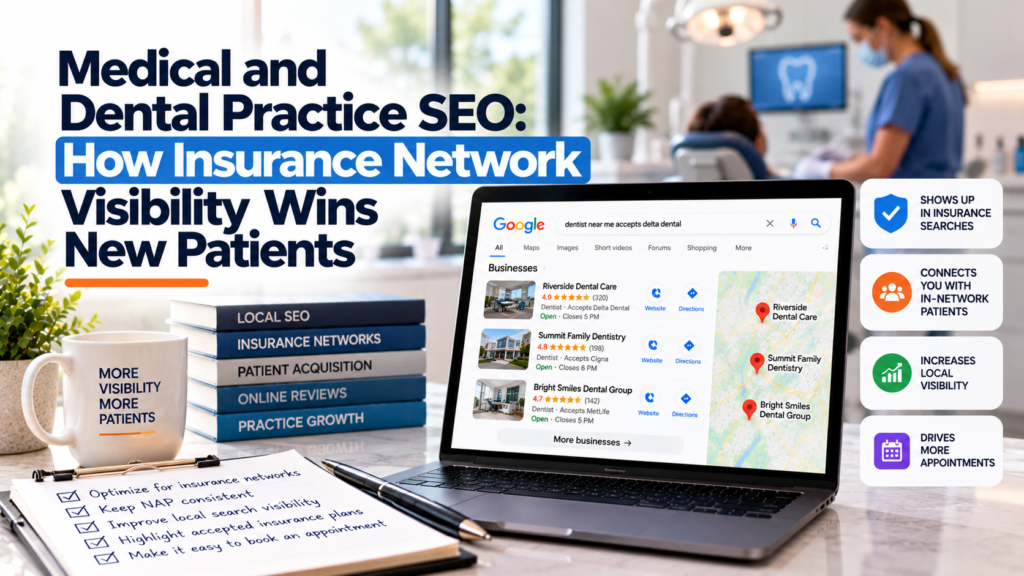
- Insurance network visibility is the one search filter unique to healthcare, and patients regularly search by specialty plus insurance plan, so your practice needs to list accepted plans in plain text across your website and Google Business Profile.
- Medical practice SEO depends heavily on your Google Business Profile: filling out every available field, including insurance options, directly affects whether you appear in the local map pack for high-intent patient searches.
- Online scheduling is not just a convenience feature. It keeps patients from bouncing off your site to a competitor, which over time supports better search performance through stronger user engagement signals.
- Patient retention email marketing feeds your SEO indirectly by generating repeat visits, review requests, and branded searches, all of which reinforce your authority in local search results.
- Audit your insurance information on your website and in every directory at least once per year. Outdated insurance listings are one of the most common and most damaging mistakes medical and dental practices make online.
Table of Contents
- Why Medical Practice SEO Is Different From Every Other Local Business
- Insurance Network Visibility: The Search Filter Most Practices Ignore
- How Medical Practice SEO Drives New Patient Acquisition
- Online Scheduling: The Conversion Feature That SEO Has to Support
- Patient Retention Email Marketing: The SEO Connection You Might Not Expect
- The Role of Local SEO in Healthcare Search Visibility
- Taking an Honest Look at Your Practice's Search Presence
Medical practice SEO is the process of making your practice show up when a potential patient searches for a doctor or dentist in your area, including the specific insurance they carry. If your practice isn’t ranking for insurance-specific searches like “pediatrician near me accepts Aetna” or “dentist that takes Cigna in [city],” you’re losing patients to competitors who made that information easy for Google to find. The good news is that most practices haven’t figured this out yet, so the window to pull ahead is still open.
Why Medical Practice SEO Is Different From Every Other Local Business
A plumber doesn’t have to worry about whether your homeowner’s insurance covers the repair before you call. A dentist does. Insurance network visibility is the one search filter that is almost entirely unique to healthcare, and it changes how patients search, how Google interprets those searches, and what your practice needs to communicate online to win those clicks.
When someone searches for a doctor or dentist, they often add their insurance plan to the query almost automatically. They’ve been burned before by an out-of-network bill, and they’re not going to risk it again. If your website and your Google Business Profile don’t clearly signal which insurances you accept, Google won’t serve you up for those searches, no matter how polished your site looks. Understanding this is the first step toward building a smarter approach to medical practice SEO.
Insurance Network Visibility: The Search Filter Most Practices Ignore
This is where medical practice SEO gets specific in a way that most generic marketing advice misses entirely. Insurance network searches aren’t just about keywords on your homepage. They’re about structured, consistent data that tells Google exactly which plans you accept and where.
What to Do About It
- List your accepted insurance plans on every relevant page. Your homepage, your services pages, and especially your “New Patients” page should all include a clear, readable list of the insurance plans you accept. Don’t bury it in a PDF download.
- Add insurance information to your Google Business Profile. Google Business Profiles for healthcare providers have fields specifically for insurance. Fill them out completely. This directly affects your visibility in the local map pack for insurance-filtered queries.
- Use natural language in your content. Write sentences like “Our practice accepts Blue Cross Blue Shield, Aetna, United Healthcare, and Cigna” rather than just showing a logo grid. Logos don’t rank. Text does.
- Create a dedicated insurance and billing page. Give Google one authoritative page to associate with insurance-related searches for your practice. Include FAQs about billing, what to bring to your first visit, and how to verify your benefits.
- Keep the information current. Insurance networks change every year. A practice that accepted a plan in 2023 and quietly dropped it by 2025 but never updated their website is actively misleading patients. Audit your insurance content at least once a year.
How Medical Practice SEO Drives New Patient Acquisition
New patient acquisition is the metric that pays the bills, and medical practice SEO is one of the most cost-effective ways to move it. Unlike paid ads, which stop the moment your budget runs out, organic search rankings keep working around the clock. A patient searching at 10 PM on a Sunday who finds your practice through a well-optimized page is just as real as one who called during office hours.
The path from search to booked appointment has gotten shorter than most practice owners realize. The American Dental Association has reported that a growing share of patients expect to find and evaluate a provider entirely online before ever making contact. That means your website isn’t just a brochure. It’s a first visit, and it needs to perform like one.
Here’s what that means practically:
- Your site needs to load fast on mobile. Most health searches happen on a phone.
- Your contact information needs to be visible without scrolling on every page.
- Your reviews need to be recent, genuine, and responded to. Patients read them like referrals.
- Your location pages need to mention the neighborhoods and surrounding towns you serve, not just your city name.
Online Scheduling: The Conversion Feature That SEO Has to Support
Getting found is only half the job. Once a patient lands on your site, you have a narrow window to convert their interest into a booked appointment. Online scheduling is one of the highest-impact features a medical or dental practice can add to their website, and it’s directly tied to how your medical practice SEO performs in the long run.
Here’s why: Google tracks user behavior. If a patient clicks your result, can’t figure out how to book, and immediately hits the back button to try a competitor, that’s a signal that your page didn’t satisfy the search. Enough of those signals and your ranking slips. An embedded scheduling widget keeps patients on your site, moving toward an appointment, and signals to Google that your page delivered.
Make your scheduling button impossible to miss. It should appear in your navigation, near the top of your homepage, and at the bottom of every service page. Test it on mobile yourself. If it takes more than two taps to start the booking process, it’s already losing you patients.
Patient Retention Email Marketing: The SEO Connection You Might Not Expect
This one surprises practice owners, but it’s worth understanding. Medical practice SEO brings new patients through the door. Email marketing keeps them from walking out the other side. And patient retention has a direct, if indirect, effect on your search performance.
Loyal, returning patients are more likely to leave you a review after a visit. They’re more likely to refer a family member who then searches for your practice by name. Branded searches (people searching specifically for your practice) are a trust signal to Google. A steady stream of them, fueled by patients who like you and come back, reinforces your authority in local search results over time.
A simple email strategy for patient retention looks like this:
- A welcome email after a first appointment, with links to your patient portal and a reminder of how to book follow-ups online.
- A recall email 5 to 6 months out for patients due for a cleaning or annual checkup.
- A seasonal check-in for patients with chronic conditions or regular treatment schedules.
- A review request email sent 48 to 72 hours after a positive visit.
None of this needs to be elaborate. It just needs to be consistent. Most practices set this up once and let it run, which is exactly what good systems should do.
The Role of Local SEO in Healthcare Search Visibility
Local SEO and medical practice SEO overlap almost completely for practices serving a defined geographic area. If you’re not showing up in the Google local map pack for “dentist near me” or “family doctor in [your city],” you’re invisible to the patients most likely to actually book with you.
The factors that move the needle in local healthcare search are the same ones that apply to any local business, but with a few healthcare-specific additions:
- Your Google Business Profile category (use the most specific one available for your specialty)
- Consistent name, address, and phone number across all online directories and listings
- Volume and recency of patient reviews on Google
- Proximity of your practice to the person searching
- Healthcare-specific directory listings (Healthgrades, Zocdoc, Psychology Today for mental health providers)
If you want to understand how local search ranking works at the foundational level, the breakdown in what Google actually looks at when ranking local businesses in the map pack lays it out without the jargon.
Taking an Honest Look at Your Practice’s Search Presence
Before investing in any campaign, it’s worth knowing exactly where you stand. Search your own practice name, then search your specialty plus your city, then search your specialty plus an insurance plan you accept. What do you see? Are you showing up in all three? Are your competitors consistently ahead of you in the insurance-specific searches?
That gap is the opportunity. Medical practice SEO is not magic, and it doesn’t happen overnight, but the practices that invest in it consistently tend to pull ahead of competitors who are still relying on word of mouth and a phone book listing that nobody opens.
If you want to know what it costs to work with a team that does this for a living, our transparent SEO pricing page gives you real numbers without a sales call first.
The practices that win the most new patients online aren’t always the best practices in the room. They’re the ones that made it easiest for the right patient to find them, verify their insurance, and book an appointment without picking up the phone. That’s what good medical practice SEO actually does.
Frequently Asked Questions
How is medical practice SEO different from regular local SEO?
Medical practice SEO includes everything local SEO covers, but it adds a layer that no other business type deals with: insurance network visibility. Patients frequently search for providers by specialty and insurance plan together, so your practice needs to communicate which plans you accept in plain text on your website and in your Google Business Profile, not just in a logo grid or a downloadable form.
How long does it take for medical practice SEO to show results?
Most practices start seeing meaningful movement in local search rankings within three to six months of consistent work. Insurance-specific search terms and local map pack rankings tend to respond faster than competitive national keywords. The timeline depends on how optimized your starting point is, how active your competitors are, and how consistently you build reviews and update your online presence.
Can online scheduling actually affect my search rankings?
Not directly, but user behavior does. If patients land on your site and quickly leave because they can’t find a way to book, that signals to Google that your page didn’t satisfy the search. Online scheduling keeps patients engaged and moving toward an appointment, which helps your site perform better behaviorally. Better behavior signals support better rankings over time.
Which online directories matter most for medical and dental practices?
Google Business Profile is the highest priority by far because it drives map pack visibility. After that, focus on Healthgrades, Zocdoc, Yelp, and your state’s insurance carrier directories. For dental practices specifically, the American Dental Association’s Find-a-Dentist tool and the directories maintained by major insurers are worth claiming. Consistency across all of them matters as much as volume.
How often should a practice update its insurance information online?
At minimum, once a year, and ideally every time your insurance contracts change. Insurance networks update their panels annually, and a practice that lists a plan it no longer accepts will frustrate patients and damage trust. Set a recurring reminder to audit your website’s insurance page, your Google Business Profile insurance fields, and your major directory listings every January or whenever you get network change notices from payers.