
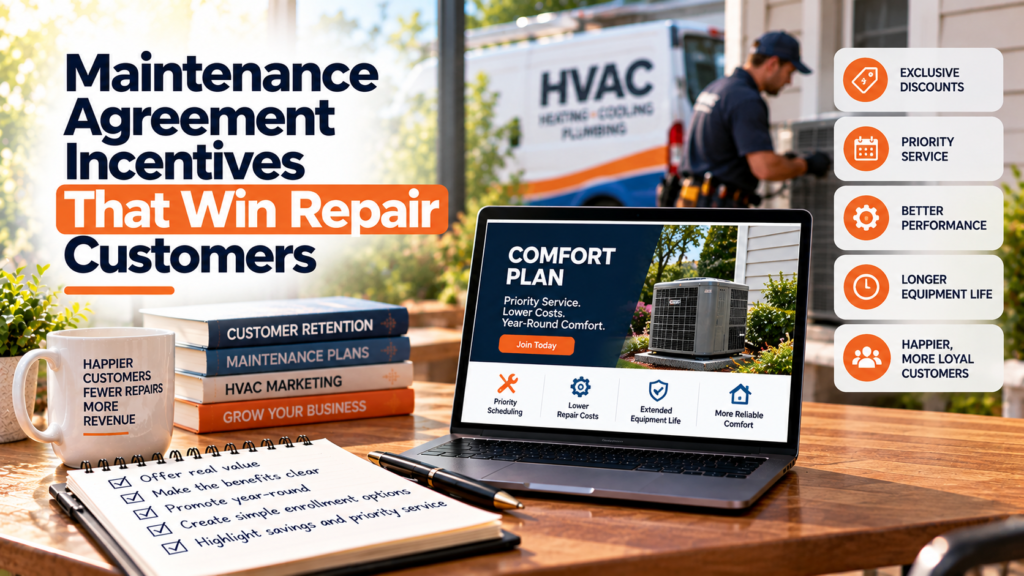
Key Takeaways
- The single strongest incentive is a credit on the repair the customer just paid for, offered before they leave.
- Priority scheduling and waived after-hours fees sell better than a percentage off future repairs, because customers remember waiting.
- Show the "member price" next to the regular price on today's invoice. Real savings on a real bill beat any brochure.
- A monthly payment option lowers the barrier, but keep an annual option for customers who won't put a card on file.
- Reward your techs for memberships, but tie the reward to renewals too, so nobody gets pushed into a plan they'll drop.
The customer who just paid you for a repair is the warmest lead you’ll ever have. They let you into their home. They watched your tech work. They paid the invoice. And then, most of the time, they disappear until the next breakdown, and by then they may have forgotten your name. The right maintenance agreement incentives are what turn that one-time repair call into a customer who stays for years.
But not every incentive works. Some pull in bargain hunters who cancel after a year. Some sound great on paper and do nothing at the kitchen table. Here’s what tends to move a repair customer to say yes, whether you run an HVAC shop, a plumbing company, an electrical contractor, or all three under one roof.
Why Repair Customers Are Your Best Membership Prospects
Think about where that customer’s head is. Their AC died, or the water heater leaked, or a breaker kept tripping. They felt the stress. They paid money they probably didn’t plan to spend. Right now, more than any other time, they understand what a breakdown costs.
That’s the opening. A cold prospect hasn’t felt the pain yet. A repair customer felt it yesterday. They also already trust your company enough to have let a tech into their house, which is the hardest part of any sale.
The window doesn’t stay open long, though. A week later the system is running fine and the stress is gone. So the best incentives are the ones you can offer right at the end of the job, or within a day or two after.
The Strongest Incentive: Credit Today’s Visit Toward the Plan
If you only try one of these maintenance agreement incentives, try this one. Offer to credit some or all of today’s diagnostic or service call fee toward the membership if they sign up before the tech leaves, or within a few days.
Here’s why it works so well. The customer doesn’t have to imagine some future savings. They get money back on a bill they’re holding right now. The math feels immediate. “You paid $129 for the trip charge today. Sign up for the plan and we’ll apply that to your first year.” The plan suddenly looks half paid for.
A softer version works too. Re-ring today’s invoice at member pricing. If members get 15 percent off repairs and no trip charge, show the customer exactly what today’s bill would have been. Seeing “$412” turn into “$318” on their own invoice is more convincing than anything printed on a flyer. A lot of field service software can do this side by side, so it takes the tech about ten seconds.
The Perks Customers Actually Care About
Owners often build a membership plan around discounts, because discounts are easy to explain. But when you ask members why they signed up and why they renew, the answers usually point somewhere else. Peace of mind, mostly. Not waiting.
These are the home service membership perks that tend to land best, roughly in order:
- Priority scheduling. Members go to the front of the line when it’s 98 degrees or the basement is flooding. Anyone who waited three days for a callback last summer gets this instantly.
- No after-hours or weekend fees. Emergencies don’t happen on a Tuesday morning. Waiving overtime charges for members is a perk people remember, because the alternative is a bill that stings.
- No trip or diagnostic charge. It takes away the “is it worth calling them?” hesitation, which keeps members calling you instead of shopping around.
- A discount on repairs. Still worth including. Ten to twenty percent is common. Just don’t make it the headline.
- Extended labor warranty. Something like an extra year on repairs done while the customer is a member. It costs you little if the work is good, and it tells customers you stand behind it.
- Price lock. Members keep their rate as long as they renew. It quietly rewards loyalty and makes canceling feel like losing something.
Notice how most of these cost you very little in actual dollars. Priority scheduling just means shuffling the board. Waived trip charges mostly come back as repair work you’d have otherwise lost to a competitor.
Bundled Plans for HVAC, Plumbing, and Electrical Shops
If you offer more than one trade, a bundled membership is one of your best tools. One plan that covers a heating and cooling tune-up, a water heater flush, and a basic electrical safety check makes the value obvious. Three visits, three trades, one price.
It also does something quieter. The customer who called you for a furnace repair now has a plumber and an electrician from your company walking through their home once a year. That’s how a heating customer becomes a plumbing customer, then an electrical customer, without a single ad. Our post on structuring a multi-trade HVAC website covers how to make that cross-sell show up online too.
Keep a single-trade option for people who only want the basics. Some customers will balk at a bigger plan. A simple ladder works well: a basic plan for one system, and a whole-home plan for a bit more.
Monthly or Annual? Offer Both
Monthly billing lowers the barrier. Nine or ten dollars a month sounds small. A hundred dollars up front makes some people pause, especially right after paying for a repair. Monthly members also tend to stick around, since the charge just keeps running in the background.
But not everyone will put a card on file. Older homeowners in particular often refuse, and they’re a big share of repair customers. So keep an annual option, and give it a small discount. Something like $9.99 a month or $99 a year, paid up front. The customer picks, and you lose fewer sales over payment style.
Incentives That Tend to Backfire
Some maintenance plan sign-up offers bring in plenty of members and then hurt you a year later.
Deep first-year discounts. Half off the first year looks great on a sign-up report. Then renewal comes, the price doubles, and a lot of those members walk. You trained them to buy on price.
Gift cards and giveaways. A free restaurant card has nothing to do with the plan. It might get a signature, but it doesn’t build any reason to stay.
Pressure. A tech who pushes too hard can lose a customer who was happy five minutes earlier. Customers can tell when they’re being sold. The best techs present the plan the same way they present a repair option: here’s what it is, here’s what it would have saved you today, no pressure either way.
Value-based plans attract people who want reliability, and those people renew. Discount-based plans attract people who want a deal, and they leave when someone else has a better one. We made the same point in our guide to selling HVAC maintenance agreements before the rush, and it holds for plumbing and electrical too.
Incentives for Your Technicians, Not Just Customers
Here’s the part a lot of owners skip when they try to convert repair customers into members. The customer incentive only works if the tech actually brings it up. And many techs don’t, because they’re fixers, not salespeople, and asking feels awkward.
A small bonus per membership sold, often called a technician spiff, changes that fast. Some shops pay a flat amount. Some pay more for whole-home plans. A few run monthly contests between trucks.
One caution. If you only pay on new signups, you can end up rewarding the wrong behavior. Techs push plans onto people who cancel in month two. A cleaner setup pays part of the bonus at signup and part at the first renewal. Now the tech wants members who stay.
Give techs a simple tool too. A one-page leave-behind, a QR code on a card or badge, or a short link they can text. The easier it is for the customer to sign up later, the less the tech has to sell in the moment.
The Follow-Up After the Job
Plenty of customers won’t decide on the spot. That’s fine. The follow-up is where a lot of signups actually happen.
A simple sequence works:
- Same day: The thank-you text or email that asks for a review can also mention the plan, with a link.
- Two to three days later: A short message reminding them the repair credit offer expires soon. A real deadline helps.
- Before the next season: A note about the tune-up members are about to get. Seeing others get scheduled first is its own nudge.
Keep it short, and don’t pile on. Two or three touches is enough. Our email marketing services are set up around exactly this kind of event-triggered follow-up, so it runs without anyone in the office remembering to send it.
Give the Plan Its Own Page, and Track It
Every text, email, QR code, and leave-behind should point to one place. A dedicated membership landing page, not a paragraph buried on the services page. List the perks in plain language. Show the price both ways, monthly and annual. Make signing up take a minute, not a phone call during business hours.
It helps on the search side too. Homeowners do search for things like “HVAC maintenance plan near me” or “plumbing maintenance plan,” and a focused page has a real shot at ranking. A good website built for local service businesses makes that page easy to find from every service page on the site.
Then track a few numbers each month. How many repair customers were offered the plan. How many signed up on the spot, and how many later. Which incentive they took. What percentage renewed. If signups are fine but renewals are weak, the problem is the service experience or the price jump, not the incentive.
The Real Incentive Is Not Having to Worry
Strip all the maintenance agreement incentives away and the customer isn’t really buying a tune-up. They’re buying the feeling that someone has their house handled. Credits and discounts help get them across the line, sure. But what keeps them is that the next time something breaks, they know who to call, they know they’ll be seen first, and they know the bill won’t have surprises on it. Build the plan around that, and maybe the incentive matters less than you’d think. Or maybe it’s just the thing that gets them to try it once.
If you want help getting more eyes on your membership offer, our free local SEO audit looks at your site, your Google Business Profile, and where competitors are pulling ahead. You can also see how we approach home services marketing or get in touch directly.
Frequently Asked Questions
What is the best incentive to get a repair customer to join a maintenance plan?
Crediting today’s diagnostic or service fee toward the first year of the plan usually works best. The customer sees an immediate return on a bill they just paid, which makes the plan feel partly paid for already.
When should a technician offer a maintenance agreement?
At the end of the repair, after the problem is fixed and the customer is relieved. That’s when they best understand what a breakdown costs. Follow up within two to three days for customers who don’t decide on the spot.
Should maintenance plans be billed monthly or annually?
Offering both works best. Monthly billing lowers the barrier and tends to keep members longer, while an annual option with a small discount suits customers who won’t keep a card on file.
What perks should a home service membership include?
Priority scheduling, waived trip or after-hours fees, a repair discount, an extended labor warranty, and a locked-in price as long as the customer renews. Seasonal tune-ups for each system covered are the foundation.
Should technicians get a bonus for selling memberships?
Yes, a small bonus encourages techs to bring the plan up. Paying part at signup and part at the first renewal keeps the focus on members who stay rather than quick signups who cancel.