
Key Takeaways
- Dental practice SEO is distinct from general local SEO because insurance network visibility is a primary search filter patients use before they ever call your office.
- Listing accepted insurance plans by name on a dedicated website page, not just in a vague catch-all phrase, directly helps you rank for insurance-specific patient searches.
- Online scheduling reduces drop-off after patients find you in search, especially for evening searches when your phones are not staffed.
- A three-email patient retention sequence targeting recall, reactivation, and post-visit review requests is the most cost-effective way to protect your existing patient base from attrition.
- Consistent upkeep of your Google Business Profile, including fresh photos, updated services, and review responses, matters more long-term than any one-time optimization.
Table of Contents
- Why Dental SEO Is Different from General Local SEO
- The 5 Core Strategies for Dental Practice SEO That Actually Works
- Dental Practice SEO Requires Consistency, Not Just a One-Time Setup
Dental practice SEO is the process of making your practice visible in local search results so that new patients in your area find you first, before they find your competitor down the street. Done right, it does not just drive website traffic. It fills your schedule with patients who match your insurance network, show up to appointments, and come back every six months. Done wrong, it wastes ad spend on clicks that never book. Here is what actually works in 2026 for dental offices that want sustainable growth, not a one-month bump.
Why Dental SEO Is Different from General Local SEO
Most local businesses compete on location and reviews. Dentists compete on those things too, but they have an additional filter that almost no other local business faces: insurance. A patient searching for a dentist is not just asking “who is nearby.” They are asking “who is nearby, accepting new patients, and takes my insurance.” That changes what good dental practice SEO looks like at every level, from your Google Business Profile to your website content to how you handle online reviews.
The American Dental Association reports that cost and insurance coverage remain the top reasons patients delay or skip dental care entirely. That means patients who do search for a dentist are specifically screening for accepted plans before they ever call. If your website and listings do not surface that information clearly, you are losing those patients to practices that do.
The 5 Core Strategies for Dental Practice SEO That Actually Works
1. Claim and Optimize Your Google Business Profile for Patient Intent
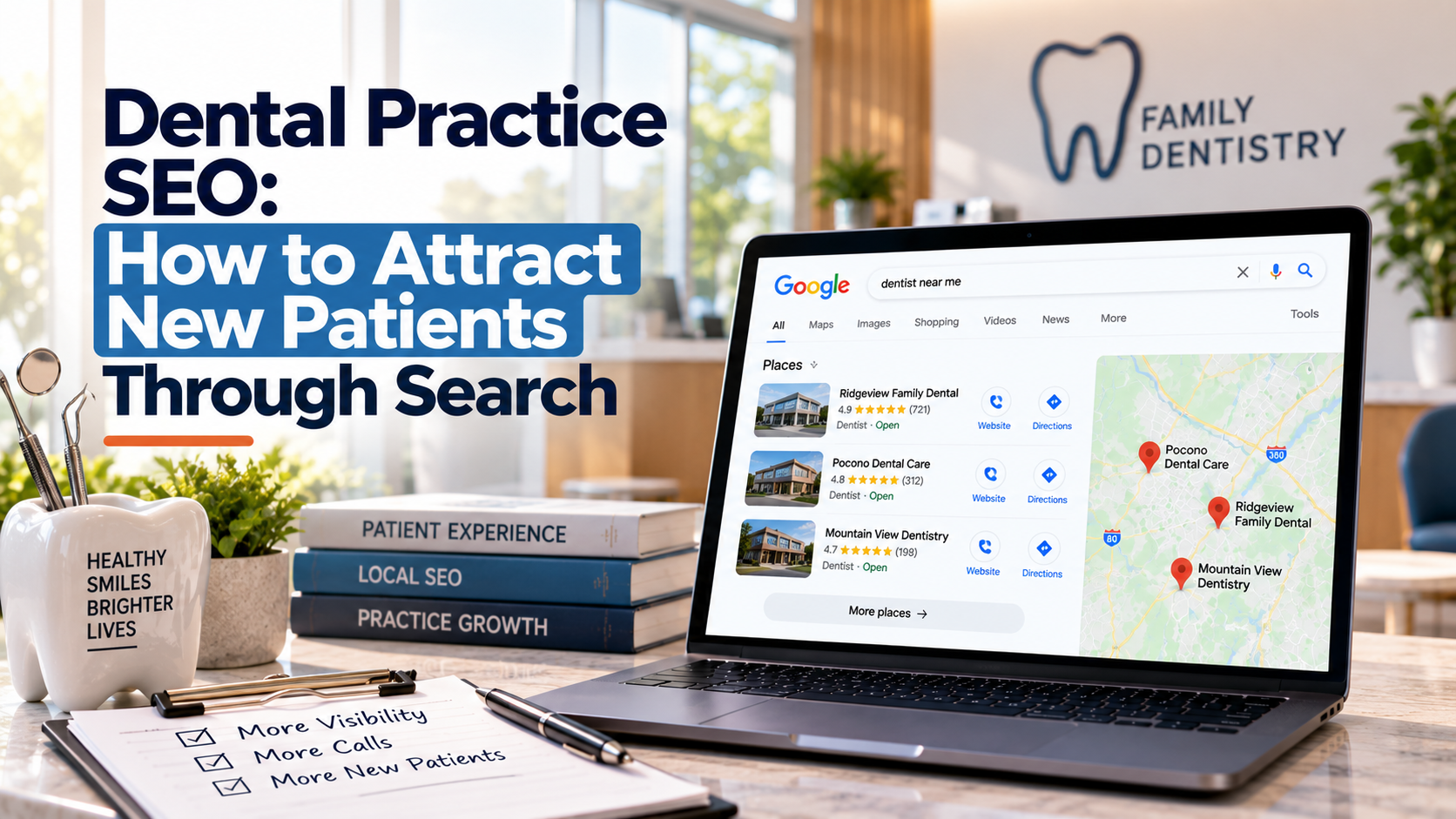
Your Google Business Profile is the single highest-leverage piece of dental practice SEO you can work on right now. It controls whether you show up in the Map Pack, which is the three-business block Google displays above the regular search results for searches like “dentist near me” or “family dentist accepting new patients.” Most dental offices set up their profile once and forget it. That is a mistake.
Here is what your profile needs to be competitive:
- Your correct primary category (“Dentist” or “Cosmetic Dentist” depending on your focus, not a generic category)
- A complete list of services, including specific ones like teeth whitening, Invisalign, or emergency dental care
- Your accepted insurance networks listed clearly in your business description
- Consistent NAP (name, address, phone) that matches your website and every directory listing exactly
- At least 20 Google reviews with a response to each one
- Fresh photos posted monthly, not just one stock image from 2019
- An online booking link connected to your scheduler
If you want to understand how Google weights proximity, relevance, and authority to decide who shows up in those results, the mechanics are explained clearly in our breakdown of what Google actually looks at when ranking local businesses in the Map Pack.
2. Make Insurance Visibility a Core Part of Your Website Content
Most dental websites bury the insurance page in the footer. Patients look for it immediately. Dental practice SEO that converts does not treat insurance as an afterthought. It treats insurance acceptance as a top-of-funnel filter that can either qualify or disqualify a new patient before they ever call.
Concretely, that means:
- A dedicated “Insurance” page that lists every accepted plan by name, not just “most major insurances”
- Those plan names in plain text on the page, not buried in a PDF or image file that Google cannot read
- A simple sentence on your homepage and your contact page confirming whether you are accepting new patients right now
- Clear language about what happens for patients without insurance (payment plans, in-house membership plans, etc.)
This is not complicated content, but it is content that your competitors are probably not doing well. A page titled “Dental Insurance in [Your City]” that names Delta Dental, Cigna, Aetna, MetLife, and United Concordia by name will rank for searches that patients are actually typing.
3. Online Scheduling Is Now a Ranking and Conversion Factor
Online scheduling for dentists is not just a convenience feature anymore. It directly affects dental practice SEO outcomes because Google tracks engagement signals. When patients can book directly from your Google Business Profile or your website without making a phone call, more of them follow through. Fewer drop-off points mean higher conversion rates from the same amount of search traffic.
More practically: patients searching for dentists after 7 PM cannot call your office. If a competitor offers online scheduling and you do not, that patient books with them. It is that straightforward. Systems like Zocdoc, NexHealth, or built-in scheduling through your practice management software (Dentrix, Eaglesoft, Open Dental) all offer embeddable booking widgets. Pick one, put it on your homepage above the scroll line, and link to it from your Google Business Profile as a booking URL.
4. Build Local Content That Answers the Questions New Patients Are Actually Asking
One of the most underused dental practice SEO tactics is writing service pages and blog content that targets specific local searches. General dental practices often skip this entirely and wonder why they are not ranking for anything beyond their practice name.
Think about what people in your city are actually searching:
- “Emergency dentist [city name] open Saturday”
- “Dentist that accepts Medicaid in [county]”
- “Affordable teeth whitening near [neighborhood]”
- “Pediatric dentist [city] accepting new patients”
Each of those is a distinct page opportunity. A 500-word page that clearly answers one of those questions, names your city, includes your practice details, and links to your booking tool will outperform a vague “Services” page almost every time. You do not need 50 blog posts. You need 8 to 12 well-focused pages that target the searches your ideal patients are typing right now.
5. Use Patient Retention Email Marketing to Keep the Patients You Already Have
Dental practice SEO is primarily a new-patient acquisition tool, but patient retention email marketing is what protects the revenue you have already earned. The industry standard for patient attrition is that practices lose 10 to 20 percent of their active patient base every year to moves, life changes, or simply drifting away. Email is the most cost-effective way to close that gap.
A basic retention email system for a dental practice does not need to be complicated. It needs to do three things:
- Send a recall reminder at the 5-month mark after a patient’s last cleaning, before they fall out of the 6-month habit
- Send a reactivation email to any patient who has not been in for more than 18 months with a clear call to action to book
- Send a post-visit follow-up 48 hours after any procedure with care instructions and a gentle ask for a Google review
That third email alone, consistently sent, will do more for your online reviews over 12 months than any review-generation tool you pay for separately. It works because the timing is right: the patient just had a good experience and the ask feels natural, not transactional.
Dental Practice SEO Requires Consistency, Not Just a One-Time Setup
The practices that build durable new patient acquisition dental pipelines are the ones that treat SEO as ongoing maintenance, not a one-time checklist. Google updates its local algorithm regularly. Competitor practices optimize their profiles. Patient behavior shifts. What ranked well 18 months ago may not rank well today without some upkeep.
If you are not sure where your practice stands right now, the most useful first step is an honest audit of your current visibility: what you rank for, where your listings have errors, and which competitors are outranking you and why. We offer a free local SEO audit that gives you a real picture of where your practice stands in local search, without a sales pitch attached.
Dental practice SEO is not a mystery. It is a set of specific, repeatable actions applied consistently to a profile, a website, and a content strategy. Practices that follow through on all five of the strategies above will outrank the ones that only do two of them, almost every time.
How long does dental practice SEO take to show results?
Most dental practices see measurable improvement in local rankings within 3 to 6 months of consistent work. Google Business Profile updates and review growth tend to move faster, sometimes within 4 to 8 weeks. Full website content and authority improvements typically take 4 to 9 months to compound into consistent first-page rankings.
Should a dental practice use paid ads or focus on SEO?
Both serve different needs. Paid ads (Google Local Services Ads in particular) can generate calls within days but stop the moment you stop paying. SEO builds a search presence that compounds over time and does not disappear when your budget changes. For most practices, the right move is to run ads short-term while SEO builds up, then reduce ad spend as organic rankings improve.
How does insurance acceptance affect dental SEO?
Insurance acceptance is a unique filter in dental search. Patients regularly search by insurance plan name, and Google surfaces practices that clearly list accepted insurances in their content and listings. Practices that list accepted plans by name on a dedicated page consistently perform better for those insurance-specific searches than practices that just say ‘most major insurances accepted.’
What is the best way to get more Google reviews for a dental practice?
The highest-converting method is a simple automated email sent 48 hours after any appointment with a direct link to your Google review page. Asking in the office works, but patients rarely follow through once they leave. An email with one clear link sent at the right moment converts significantly better than verbal asks alone.
Does online scheduling actually help a dental practice rank higher?
Online scheduling does not directly change how Google’s algorithm scores your site, but it improves conversion rates from existing search traffic and engagement signals. More patients who find you actually book, which means your profile and website generate more bookings per visit. That activity, over time, contributes positively to how Google perceives your practice as an active, relevant local business.