
Key Takeaways
- Your homepage headline should name a specific type of person and a specific problem, not a vague aspiration like 'live your best life,' because specificity is what stops a skeptical visitor from leaving in the first 30 seconds.
- Testimonials that describe a concrete before-and-after situation build far more trust than general praise, so when asking clients for feedback, ask targeted questions about what changed and how long it took.
- A dedicated discovery call page that explains what the call covers, what to prepare, and what happens next removes friction at the moment of decision and reduces no-shows from mismatched expectations.
- Publishing even one piece of content per month that directly addresses a question your ideal client is already asking gives visitors a low-stakes way to experience your thinking before they commit to a call.
- Beautiful design does not compensate for vague copy. Rewrite the headline and update the testimonials first, then refine the visual design around the words that are already working.
Table of Contents
- Why Most Coaching Websites Lose Visitors Before Page Two
- The 6 Life Coach Website Design Elements That Actually Convert
- The Structural Comparison: What Skeptical Visitors Actually See
- One Note on Local and Search Visibility for Coaches
- The Real Problem With “Pretty” Coaching Websites
- Where to Start If Your Current Site Is Not Working
A strong life coach website design does one specific job: it convinces a stranger who has never met you that you are safe, credible, and worth 45 minutes of their time on a discovery call. That is it. Everything else on your site is either helping or hurting that single goal. Most coaching websites fail at this because they are built around what feels comfortable to the coach rather than what a skeptical first-time visitor actually needs to see.
The wellness and coaching space has a low barrier to entry. Someone can finish a weekend certification and launch a website by Monday. Your potential client knows this. They are not just evaluating your services. They are deciding whether you are the real thing or one of the dozens of similarly worded coaches they have already scrolled past. Your website is where that decision gets made, usually in under 30 seconds.
Why Most Coaching Websites Lose Visitors Before Page Two
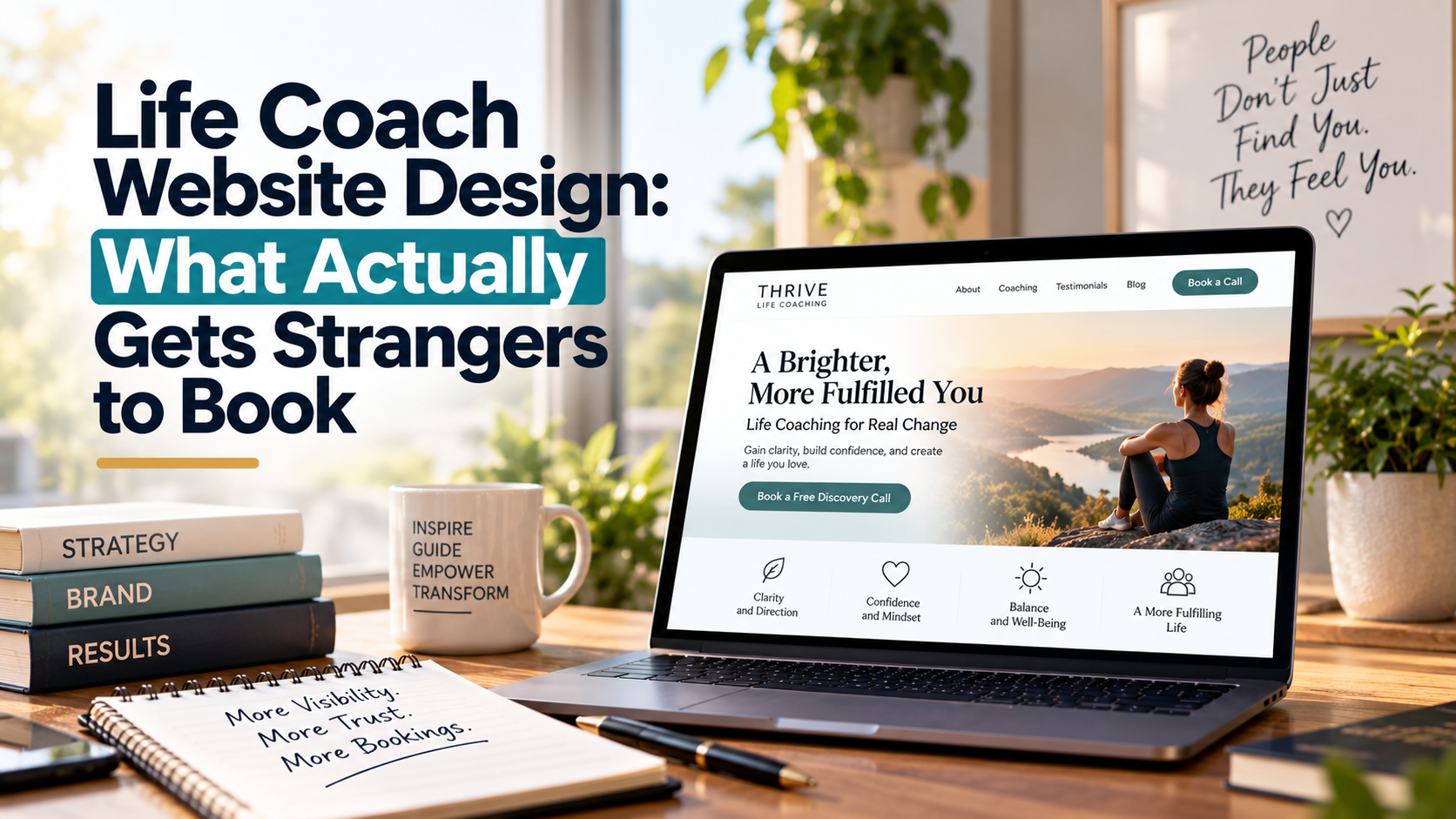
Here is what a skeptical visitor sees when they land on a generic wellness coach website: a hero image of someone meditating near water, a headline that says something like “Transform Your Life,” and a paragraph about living authentically and reaching your full potential. Then they leave.
None of that is specific. None of it tells the visitor who you help, what problem you solve, or why your approach is different from the coach they checked out 10 minutes ago. Vague language reads as a warning sign, not a welcome mat.
Fixing your life coach website design does not require a complete rebuild. It requires being far more specific than feels comfortable, and structuring the page so trust builds in the right order.
The 6 Life Coach Website Design Elements That Actually Convert
1. A Headline That Names the Problem, Not the Philosophy
Your headline is the first real test. “Certified Life Coach Helping Burned-Out Corporate Women Reclaim Their Time” will outperform “Live a Life You Love” every single time. The first sentence tells the visitor they are in the right place. The second tells them nothing.
Write your headline as if you are finishing this sentence: “I help [specific person] who is dealing with [specific problem].” If you find yourself writing about transformation, journeys, or potential, start over. Those words show up on every coaching website. They are invisible.
2. A Short “Who This Is For” Section Near the Top
One of the most effective trust-builders in life coach website design is a short, honest list of who you work with best. It feels counterintuitive because you worry about excluding people. But specificity attracts. When someone reads a bullet point that describes their exact situation, they feel seen. That feeling is worth more than reaching a slightly wider audience.
Consider a list like this near the top of your homepage or services page:
- You have been high-functioning for years but feel completely empty.
- You are good at your job but cannot explain why you dread Monday mornings.
- You want to make a major life change but keep talking yourself out of it.
- You have read the books and done the journaling. You need someone to actually work through it with you.
That kind of list does real filtering. It brings the right people closer and lets the wrong ones self-select out. Both outcomes are good for your business.
3. Social Proof That Shows Results, Not Just Feelings
Testimonials are standard on every coaching website. The problem is that most of them say things like “Working with Sarah changed my life” or “I feel so much better.” Those quotes are easy to dismiss because they are vague and unverifiable.
The testimonials that build real credibility in a coaching website trust strategy include a before and after. What was the person’s situation before? What specifically changed? How long did it take? “Before I started working with her, I had put off leaving my job for three years. Six months later I gave notice and started my own business” is a testimonial. “She helped me so much” is not.
When you ask clients for feedback, ask specific questions: What were you struggling with when we started? What has concretely changed? What would you tell someone who is on the fence? Guide them toward useful answers and you will get testimonials that actually move visitors toward booking.
4. A Credentials Section That Explains the “So What”
Listing your certifications is fine. But most visitors do not know the difference between a 200-hour ICF-accredited program and a weekend course. If you just list the credential without context, it does not do the work you think it does.
For each major credential or relevant experience, add one sentence that explains why it matters to the client. “ICF-accredited coach (600+ training hours, which means I have spent more time learning this than most coaches spend in their first two years of practice)” is more useful than a logo and an acronym. Do the translation work for your visitor so they do not have to.
The same principle applies to lived experience. If you went through the specific struggle your clients face and came out the other side, say that plainly. It is relevant, and it differentiates you from coaches who only have academic training in the area.
5. A Discovery Call Page That Sets Expectations Clearly
Most coaches have a booking button. Fewer have a page that actually prepares the visitor for what the call involves. A dedicated discovery call page that answers three questions will reduce no-shows and bring better-fit clients to the call:
- What will we talk about during the 30 or 45 minutes?
- What should I prepare or think about beforehand?
- What happens after the call if it is a good fit?
When a visitor knows exactly what they are signing up for, the decision to book becomes much easier. Ambiguity creates friction. Removing that friction is one of the highest-leverage moves in life coach website design.
6. Content That Demonstrates Your Thinking, Not Just Your Services
Blog posts, a podcast, a free resource, a newsletter. Pick one. A visitor who finds a piece of your thinking useful before they ever talk to you has already experienced a version of working with you. That is a dramatically shorter path to a discovery call booking than cold traffic hitting a services page.
This is especially important in healing arts marketing, where trust is the entire purchase decision. A potential client does not just need to believe you are qualified. They need to believe you think the way they think, that you get it. Published content is how you show that before the first call.
You do not need to write weekly. One well-written post per month that directly addresses a specific question your ideal client is already asking will compound over time and keep working for you without any ad spend.
The Structural Comparison: What Skeptical Visitors Actually See
Here is a direct look at two homepage structures. Both belong to coaches with similar credentials:
Version A: Inspiring hero image. Headline: “Awaken Your Best Self.” Brief bio. List of services. Testimonials with first names only. Book a call button.
Version B: Plain professional photo. Headline: “I help first-generation professionals stop overworking and start making decisions they actually stand behind.” Short “who this is for” list. Credentials with context. Three full testimonials with specific outcomes. A short blog post linked in the nav. A discovery call page that explains the process. Book a call button.
Version B earns a booking. Version A earns a scroll and a tab close. The content is probably interchangeable. The structure is not.
One Note on Local and Search Visibility for Coaches
Most life coaches operate virtually, which changes the SEO picture compared to a purely location-dependent service. But if you serve a specific region or have an in-person option, local search matters more than you might think. We write primarily about local digital marketing for service businesses, and the same foundational principles around trust signals and specificity apply across industries. If you are curious how local search visibility works in detail, our guide on local SEO for plumbers walks through the mechanics of how Google evaluates service businesses in a geographic area, and most of it translates directly to any service provider trying to get found in their region.
The Real Problem With “Pretty” Coaching Websites
A lot of wellness coach websites are genuinely beautiful. Good photography, clean fonts, calming colors. And they do not convert because beautiful is not the same as convincing.
Discovery call bookings come from specificity, sequenced trust-building, and removing friction at the moment of decision. A site that prioritizes aesthetics over those three things is doing interior design work when the plumbing is broken.
Your life coach website design should be clean and professional, yes. But every design decision should be in service of that visitor’s question: “Is this person the right coach for my specific situation?” If a design element does not help answer that question, it is decoration.
Where to Start If Your Current Site Is Not Working
If you are not getting discovery call bookings at a rate that makes sense for your traffic, start with the headline and the testimonials. Those two elements have the highest impact on whether a visitor moves forward or leaves. Rewrite your headline to name a specific person and a specific problem. Go back to your best clients and ask them for outcome-focused feedback using the specific questions above.
Do those two things before you touch the colors, the layout, or the font. The words do more work than the visuals in coaching website trust-building. Once the words are working, then refine the design around them.
FAQ’s
What should a life coach website homepage actually include?
At minimum: a specific headline that names who you help and what problem you solve, a short “who this is for” section, outcome-focused testimonials, a credentials section with context, and a clear path to booking a discovery call. Vague inspiration-based copy without specifics rarely converts a first-time visitor.
How long should a coaching website be?
Length matters less than structure. A short homepage that builds trust in the right order will outperform a long one that leads with philosophy. Most coaches need a homepage, a services or working-with-me page, a dedicated discovery call page, an about page, and at least a few content pieces. Start with those before adding anything else.
Do I need a blog if I am a wellness or life coach?
Not necessarily a blog specifically, but some form of published thinking helps significantly. A single piece of content that directly answers a question your ideal client is already searching for builds trust faster than any sales copy can. One solid post per month is enough to start seeing results over time.
How do I get better testimonials from coaching clients?
Ask specific questions instead of just asking for feedback. Try: What were you dealing with when we started working together? What has concretely changed since then? What would you tell someone who is hesitant to book? Those prompts produce outcome-focused testimonials that are far more convincing than generic praise.
Should a life coach invest in local SEO or focus on national visibility?
That depends on your practice model. If you work exclusively online, local SEO matters less. But if you serve a specific region or offer in-person sessions, local search visibility can drive real qualified traffic. Either way, getting found starts with a website that converts the traffic you do receive, so site structure comes first.